On my last article, Unbekoming is a Lie, I linked some of my articles on Charles Eisenstein, giving my evidence that he’s intentionally misleading us and is possibly a covert intelligence asset. I had written these before finding out that he represented as his own the phrase I coined on his comment thread, tonic masculinity. He also posted jarring photos of a Salvadoran prison, said to be taken by his friend, that were later shown to be AI generated. The rest of the four articles use Alison McDowell’s research or follow my own clues.
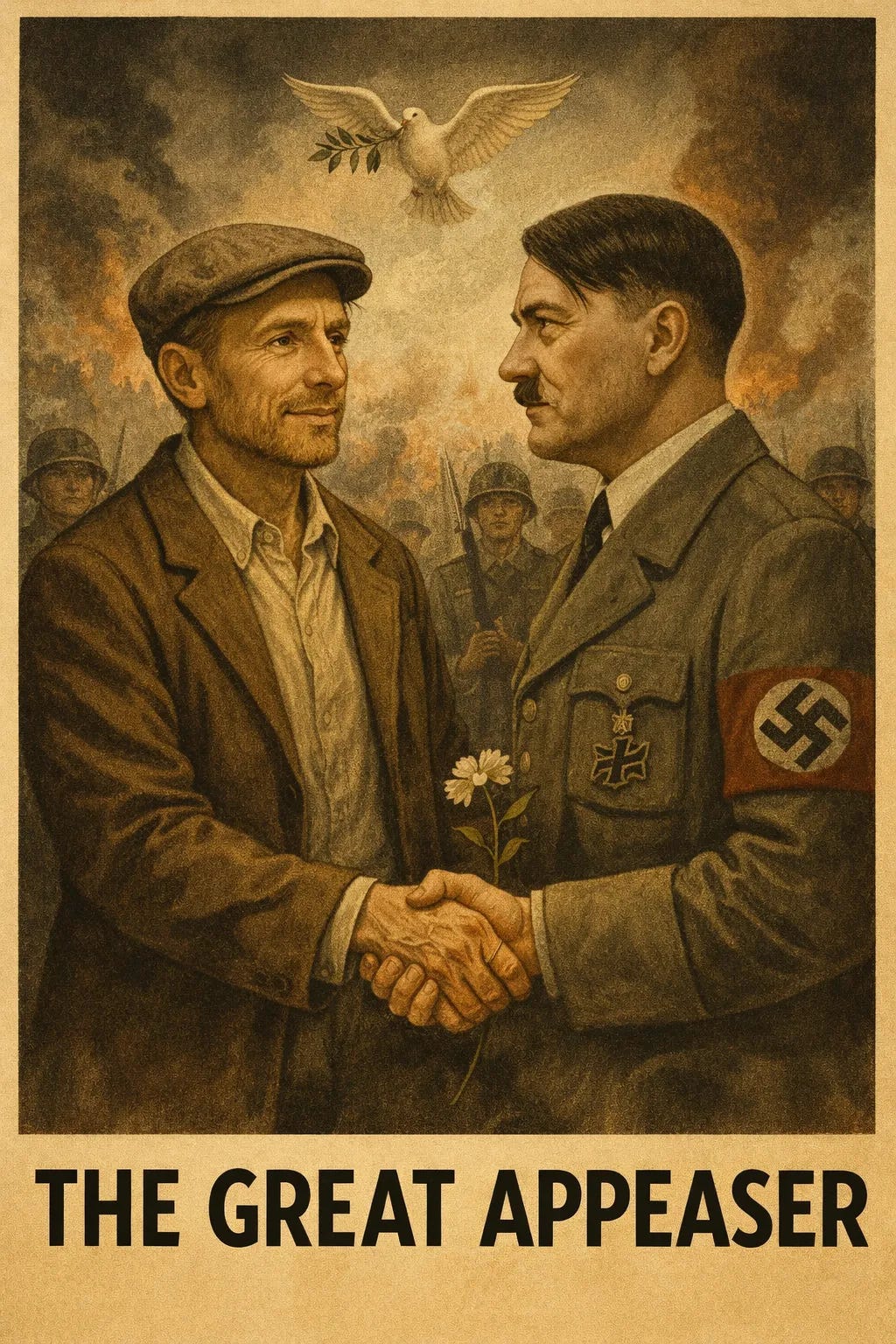
Because of this, Frontera Lupita sent me to an article by someone called Turfseer who was critical of Eisenstein’s article Venezuela: An Evil Omen. Turfseer’s article was called The Great Appeaser: Why Moral Complexity Can Become an Excuse for Doing Nothing. It compares Maduro to Hitler and Trump, I assume, to Churchill who was NOT an appeaser like Chamberlain. It begins with curious AI art in which Hitler is shaking hands with his right hand but it’s attached to his left arm. That was only the beginning of what I felt Turfseer got wrong about Hitler and Maduro.
To my surprise, I agreed with every word that Charles Eisenstein wrote. Maybe I shouldn’t be surprised. He’s always saying the same thing I am, even using my words. It was my love of his writing and perspective that drew me to him in the first place, and to all the good people I met through his comment thread.
Turfseer seems a good and smart person, who’s written 40+ songs on the scamdemic. His facility with words is demonstrated in his arguments, and his blog is read by others I admire. He cites Jon Rappaport as providing his facts and logic.
As I’ve often said, the important arguments are with those on the same side. ‘Speaking truth to power’ is mere virtue signaling. We need to understand the ways in which good people are being misled. And perhaps I’m wrong, like I may be about Charles Eisenstein. We can all mistake our own feedback bubbles for how every reasonable person thinks.
But sooner or later, you’ll be on a plane with a chatty neighbor who wants to tell you why defending Ukraine was essential for democracy. You’ll need facts and logic at your fingertips, to explain it to someone with the negative starting point of mainstream information or faux grassroots media, aka astroturf.
And after a futile hour of debate, if you’re lucky, you’ll get off the plane and happen to chat with the woman who was in the row in front of you. She’ll tell you she texted her daughter about the well-informed woman who SCHOOLED the know-it-all guy. She’ll ask if you’re a professor and it will all be worth it, that squandered hour.
So be prepared. Here are my ways to argue with someone who’s wearing imperial blinders. Good luck.
Frontera Lupita sent me here because my latest article references several others in which I critique Eisenstein. However, my reasons to critique him are different than yours. I think you’re unclear on the concept of sovereignty. If justice is blind, then any statement of ethics needs to be reversible, i.e. US Presidents may be kidnapped in an assault on the White House, taken to a foreign country and imprisoned, possibly executed. Would you agree that should NOT be a violation of international law?
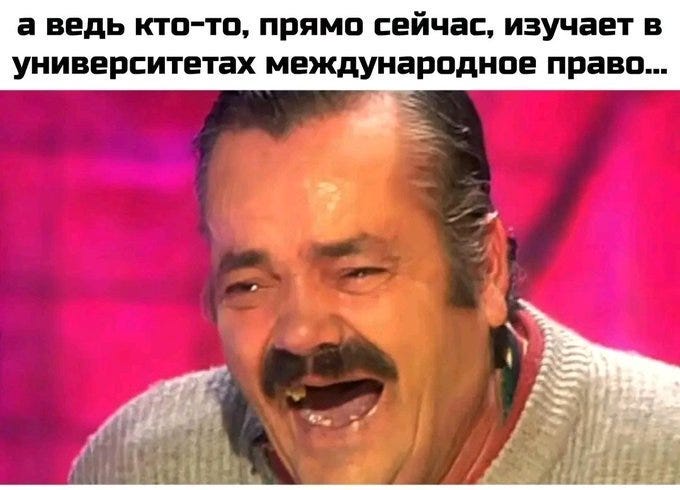
Russian meme: “but indeed someone, right now, studies international law in a university…” (thanks, Rat) I continued:
What aggression against the US do you think Maduro committed? You certainly couldn’t invoke drug smuggling. First, isn’t it the responsibility of customs and border security to keep drugs out of the US? No one’s accusing him of forcing drugs on America, as the US did to China during the Opium Wars. And he’s not using diplomatic immunity to get drugs in, like the Iran-Contra affair, operating from Clinton’s hometown airbase when he was governor. At worst, he’s allowing drug smugglers to operate out of Venezuela—which would be like making Trump liable for every drug smuggler out of the US. But even that’s more of a stretch for Maduro than it would be for Trump.
Maduro’s been accused of owning weapons. Huh? A President in his own home country can’t own weapons? If Trump owns any weapons, can he be extradited on that basis?
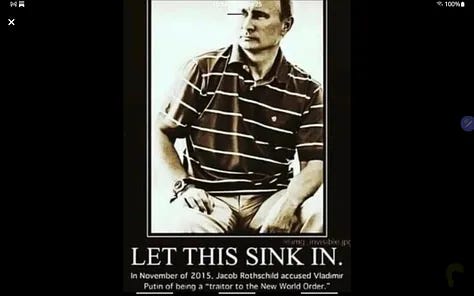
While Neville favored what you call appeasement, Rothschild wanted revenge. So Churchill was put in power and his gambling debts—that were about to lose him his manor—were paid off. Churchill was the first to ever bomb civilian cities behind enemy lines, to set up Hitler to bomb London. Enthusiasm for the war was flagging, so Churchill sacrificed London.
We’re being played by all of these actors, Eisenstein included. Don’t fall for it.
I think you’re missing what I’m actually criticizing.
This isn’t about whether the Maduro operation was clean, legal, or wise. You can believe it was reckless, illegal, or imperial overreach without adopting Eisenstein’s worldview. My objection is not “America good, Venezuela bad.” It’s that Eisenstein uses U.S. misconduct as a reason to stop making judgments altogether.
That’s appeasement.
Eisenstein’s answer to “Maduro did terrible things” is always: conditions produced him. That sounds thoughtful until you realize it applies to literally anyone, at any time. Once you accept that logic, no leader is ever meaningfully responsible for anything. History becomes therapy, not accountability.
He treats moral judgment as childish.
Calling someone a bad actor, an aggressor, or a tyrant is dismissed as “binary thinking.” But history doesn’t move forward without drawing lines. Refusing to draw them doesn’t make you wise—it just delays consequences until they’re worse.
That’s why the Hitler analogy is relevant—not because Maduro equals Hitler, but because the logic is the same. Appeasers didn’t think Hitler was harmless. They thought confrontation was worse. They thought judgment was dangerous. They thought understanding the “conditions” mattered more than stopping the behavior. And they were catastrophically wrong.
As for the alternative history being offered here—Hitler as a Rothschild agent, Churchill sacrificing London, secret banking plots—there’s simply no credible historical evidence for any of it. These claims rely on speculation, genealogical guesswork, and reinterpretations that exist almost entirely outside mainstream historical scholarship. You can believe them if you want, but they don’t overturn the basic, documented reality of how appeasement worked or why it failed.
That kind of revisionism doesn’t sharpen analysis—it muddies it. It replaces documented history with a grand puppet-master narrative that conveniently removes responsibility from the actual actors involved. Ironically, that’s the same move Eisenstein makes, just in spiritual language instead of conspiratorial language.
Thanks for responding, Turfseer. We’re both agreeing (maybe) that Eisenstein is intentionally misleading, although perhaps you’re just saying he’s mistaken. Where you differ from Eisenstein is that people SHOULD be judged as good or bad, moral or evil, by those assumed to be morally superior. Where I differ from Eisenstein is that BEHAVIORS should be judged as good or bad, moral or immoral, no matter who does them. When behaviors in one country affect the people of another, that behavior should be stopped by coordinated action by other countries who stand against it. The first level of nonviolent consequence would be refusing to trade, followed by refusing to trade with anyone who does trade with them.
Maduro owning firearms is certainly not a threat to anyone in the US. What are his acts of aggression to the US? That’s not rhetorical, I want to know what you think.
If a country allowing or even enabling drug smuggling into the US is the act of aggression, the President of Mexico should have been kidnapped, followed by the President of Columbia. That would eliminate 90% of the cocaine in the US. The fentanyl produced in Mexico is supplied by China and India so—if fentanyl deaths are his concern—Trump should refuse to trade with them until they tighten their own security around the precursor chemicals.
Did you read any of my research on Hitler, Turfseer, before calling it ‘speculation, genealogical guesswork, and reinterpretations that exist almost entirely outside mainstream historical scholarship’? I will certainly agree with the latter but I didn’t realize that you’re someone who thinks the mainstream tells the truth. I haven’t met anyone before on Substack who used mainstream as a positive attribute.
I don’t believe in believing, or in authority. I encourage you to either read one of the articles and post there what you disagree with, citing facts and logic, or give the benefit of the doubt that I’ve done more research in my 25+ articles than you have, and may know things you don’t. Rejecting my conclusions without looking at my evidence isn’t scholarship.
Thanks for laying this out, Tereza. I think we’re closer on some things than it might look at first glance. I agree that behaviors matter, and that harmful behaviors affecting other countries should be confronted—preferably through coordinated, non-military means wherever possible.
Where I part ways is narrower and simpler. My critique of Eisenstein isn’t that he’s “wrong on the facts” so much as that his way of reasoning consistently dissolves responsibility into context. Over time, that habit tends to discourage judgment at precisely the moments when judgment matters. That’s what I mean by appeasement—not defending people, but softening responses until lines disappear.
On Maduro specifically: I’m not arguing that drug trafficking alone justifies any particular action, nor am I defending a blanket “kidnap the leader” model. My point is about moral clarity, not endorsing every tactic or precedent.
As for the WWII material: I’m not dismissing your work out of hand, and I’m certainly not claiming the “mainstream always tells the truth.” I am saying that extraordinary historical claims need very strong, widely corroborated evidence, and I don’t have the time or interest to wade through dozens of articles to adjudicate them here.
If there’s one piece you think best represents your case—something concise that you feel stands on its own—I’m open to looking at that. If not, that’s fine too. I’m comfortable keeping this discussion focused on Eisenstein’s public arguments and the logic behind them.
Either way, I appreciate the thoughtful engagement.
Thanks for your kind response, Turfseer. I also think we’re closer than appears at first glance. We agree on Eisenstein, so there’s not much point to quibbling on why. My steps in Have a Better Argument is to state the question, define the terms, and say why it matters. I’m still trying to figure out your position. If not doing anything to Maduro would have been appeasement, what should have been done and on the basis of what actions against the US? How would that apply in reverse?
On ‘Hitler’, I’ll focus on the most recent in which I state: “Regardless of whether [Hitler’s grandfather] was Meyer Amschel Rothschild, the important question is whether Schicklgruber was Rothschild’s agent with a playacting script that subverted Germany’s anti-Rothschild rebellion from within, while seeming to be leading it. I’ll quote from Judea’s War on Germany to show how ‘Hitler’ is set up by denouncing him and how that ‘forced’ him to create ‘Israel’ at Germany’s expense.
I would assume that we agree on the trope ‘All wars are banker’s wars.’ If the world wars were really between Germany and Rothschild, then it’s Rothschild and his cronies who defeated Germany. And we’re living under the rule of the bankers today because we don’t understand that: https://thirdparadigm.substack.com/p/was-schicklgruber-an-actor-playing
On Maduro: As I understand it, the U.S. claim isn’t that Maduro launched a military attack on the U.S., but that his government knowingly enabled large-scale drug trafficking that materially harmed Americans. Whether that justifies the specific tactic used is debatable, but that’s the basis being asserted.
On Hitler: I appreciate you pointing me to your work, but that historical reconstruction is well beyond my purview and what I was writing about. My analogy was about appeasement logic, not hidden bloodlines or secret scripts. When I hear Hitler (or Hamas), I don’t start mapping international bankers — my inner Lost in Space robot just lights up and says: “Danger, Will Robinson. Danger.”
Sometimes pattern recognition beats genealogy charts.
Thanks but I wasn’t asking for the US claim. I’m trying to figure out your position. If not doing anything to Maduro would have been appeasement, what should have been done and on the basis of what actions against the US? How would that apply in reverse?
What would you do as President that would not be appeasement?
Fair question. Here’s my position, drawing largely from Jon Rappoport’s analysis.
Appeasement wouldn’t have meant “do nothing.” It would have meant looking the other way while Venezuela became a forward base for rival powers. What should have been done—and justified openly—is confronting concrete strategic threats in our hemisphere: Russian military advisors, Iranian drone operations, Chinese control of oil and rare-earth minerals, and the use of Venezuela as a hub for regional destabilization.
A non-appeasing posture would have been:
State clearly that foreign military and weapons systems from adversarial powers in our backyard are unacceptable.
Demand their removal.
Act to dismantle those installations if diplomacy failed—and say that’s the reason, not hide behind fuzzy legal or moral narratives.
In reverse, I’d expect the same standard: if the U.S. allowed hostile powers to set up military infrastructure near another major power’s borders, we shouldn’t be shocked if that power pushed back.
Where I part company with Eisenstein is that he treats drawing those lines as immoral “binary thinking.” I don’t. Recognizing real strategic danger and acting on it isn’t warmongering—it’s how you prevent worse outcomes later.
As I’ve said, I decide my views based on facts and logic, not authority, so I’ll respond to those. You write, “Venezuela [is] a hub for regional destabilization. A non-appeasing posture would have been: State clearly that foreign military and weapons systems from adversarial powers in our backyard are unacceptable. Demand their removal.”
By ‘backyard’ do you mean the Monroe Doctrine terminology of the Western Hemisphere? So foreign military advisors, drone operations, and control of oil and minerals on another continent in the same hemisphere is unacceptable?
I’m happy to see that you and Rappoport are supportive of Russia’s defense of its border against all of these that the US/ NATO placed in Ukraine, although you could add bioweapons labs and puppet gov’ts installed by coup.
Should the US start with the removal of its 1000 global military bases in other people’s countries? Turfseer, this is a shocking level of hubris and hypocrisy to say that another continent belongs to the US.
You write, “if the U.S. allowed hostile powers to set up military infrastructure near another major power’s borders, we shouldn’t be shocked if that power pushed back.” What this seems is that might makes right. If a country isn’t a ‘major power,’ then it’s perfectly fine to set up military infrastructure even within its borders. It’s only good strategy for the US to be circling Iran and Russia, China with Taiwan. Morality has nothing to do with it.
And going back to Hitler, you write, “When I hear Hitler (or Hamas), I don’t start mapping international bankers — my inner Lost in Space robot just lights up and says: “Danger, Will Robinson. Danger.” That’s internalizing the voice of R2D2 as self-censorship: “Abort research mission! Terminate thought immediately! Cognitive dissonance and pitfalls to authority ahead! Prepare to capsize!!!”
I don’t know what ‘historical reconstruction’ means. Isn’t all history a construction of the past using the clues of facts and logic? What you’re saying is ‘History is well beyond my purview.’ That’s okay but then don’t present history as a precedent on which to base your morality of current events.
You write, “Sometimes pattern recognition beats genealogy charts.” How do you interpret this statement as depending on genealogy?: “Regardless of whether [Hitler’s grandfather] was Meyer Amschel Rothschild, the important question is whether Schicklgruber was Rothschild’s agent ...” I dismiss bloodlines and look at the patterns of money flow, him being put into power by Rothschild warmongers, his statements and actions.
If you don’t want to do the research, concede the point that I know more about it than you do. But asking for one article and then blowing that off as beneath your ‘pattern recognition’ is smarmy scholarship.
Let me be very clear, because this keeps getting reframed in ways I don’t accept.
First, no, I am not saying “the Western Hemisphere belongs to the U.S.” That’s your gloss, not my claim. What I am saying is that states react to nearby military threats whether we like it or not. That’s not moral endorsement; it’s descriptive reality. Pretending otherwise doesn’t make the world safer—it just blinds you to how power actually behaves.
Second, pointing out that Russia reacted to NATO expansion does not obligate me to pretend all reactions everywhere are morally equal or strategically wise. You keep collapsing “understanding how states behave” into “endorsing might-makes-right.” I’m doing the former, not the latter. Refusing to recognize danger doesn’t make you principled—it makes you unprepared.
Third, on hypocrisy: yes, the U.S. has bases all over the world. Yes, that creates blowback. None of that refutes my point about appeasement logic. Saying “America has done worse things” is not an argument against identifying real threats or drawing lines anywhere, ever. It’s just a veto on judgment.
Fourth—and this matters—I am not obligated to accept your historical reconstruction as a prerequisite for discussion. History is constructed, but not all constructions are equally grounded. When a framework requires secret handlers, inverted villains, hidden scripts, and demands that skepticism be treated as intellectual failure, I’m allowed to say: this is beyond my scope and not persuasive to me. That’s not “self-censorship.” It’s discernment.
Which brings me to Hitler. My Lost in Space line wasn’t “abort thought.” It was the opposite: some patterns are obvious enough that you don’t need a 30-page genealogy to recognize danger. When an ideology produces mass violence, territorial conquest, and industrialized killing, my moral antennae don’t wait for a banking flowchart to activate.
If that’s not a conversation you want to have, that’s fine. But I’m not surrendering judgment just to keep the debate going.
I keep reframing your arguments using ethical consistency, so that the same behavior under the same circumstances is right or wrong no matter who’s doing it. Your subtitle is “Why Moral Complexity Can Become an Excuse for Doing Nothing.” You define ‘doing nothing’ as appeasement. Your argument is that Trump was morally justified, even obligated, to do ‘something’ about Maduro because he supposedly allowed ‘foreign military and weapons systems from adversarial powers in our backyard.’
‘Our backyard’ was your phrase. Venezuela isn’t in the US and doesn’t border the US. It’s an entirely different continent with many other countries between it and us. You call it OUR backyard but, according to you, you’re not saying “the Western Hemisphere belongs to the U.S.” What does the word OUR mean?
Is that your AI art, btw, in which Hitler’s right hand extends from his left arm? You have a peace dove flying above, an eidelweiss flower between them, and he’s shaking hands with a nice, working class guy above the bold title ‘The Great Appeaser.’ So you’re comparing Maduro to Hitler, and Charles Eisenstein to Neville Chamberlain, but this is just ‘descriptive reality’ and not a statement about morality?
You say this is ‘about how states behave.’ States don’t have behaviors, only humans do. Eisenstein’s article, which I’ve now read, is a severe critique of Trump’s behavior as a new frontier in lawlessness. I’m not an Eisenstein fan but I agree with every word in this article. You’re all for judging Maduro as good or bad and acting on it, but we should NOT be judging Trump’s actions as good or bad. Would we not be appeasers of Trump if we don’t sort through the moral complexity of when it’s justified to kidnap a foreign president?
Venezuela is 2000 miles away from the US. Is 2000 miles what you consider near our border? Are you suggesting that it poses a danger to the US? From my sources, it’s Israel who considers Venezuela a threat, which is even further away.
Ukraine is on the actual border of Russia, who had removed their own nuclear weapons on the condition that it be kept neutral. You say, “pointing out that Russia reacted to NATO expansion does not obligate me to pretend all reactions everywhere are morally equal or strategically wise.” So Trump taking over a country 2000 miles away is an act of defense but Putin responding to a US coup and NATO military on Russia’s border is not morally equal or strategically wise?
I have NEVER asked you to accept my conclusions. You asked for the evidence to be put into one article and then refused to read it. You’re not disagreeing with me because you have no idea what I say in the article. If you had, you wouldn’t put nonsense like ‘a 30 page genealogy’ and force me to repeat a third time that I’m looking at Hitler being Rothschild’s agent.
But let’s go with the mainstream narrative. Your argument is ‘Maduro bad. Hitler bad. Therefore appeasement bad.’ You see Hitler as “an ideology [that] produced mass violence, territorial conquest, and industrialized killing. Let’s compare Maduro to Netanyahu on those three measures. Can you give any examples of these for Maduro? I could—and have—filled multiple articles with examples for Netanyahu.
So if you’re looking at these as the danger signs that people miss until it’s too late, don’t you think we should be kidnapping Netanyahu and his wife, and putting them on trial? I just heard that Maduro’s wife is being denied medical care for the bruises on her face and broken ribs inflicted during the assault. Is this behavior you think is self-defense? Because it seems like egotistical thugs to me. I don’t know how any moral person can defend it.
Here’s the basic problem with your framing, Tereza: you keep redefining “ethical consistency” as “nobody gets to act unless the world is already morally perfect.” That isn’t consistency — it’s a veto.
A few direct pushbacks:
1) “Millions are cheering” isn’t CIA mind-control — it’s evidence of regime hatred.
You don’t have to like Trump to acknowledge a plain reality: large numbers of Venezuelans (especially in the diaspora) celebrated Maduro’s removal. That doesn’t automatically make every U.S. tactic wise, but it does undercut the idea that this was simply an unprovoked kidnapping of a beloved, legitimate leader.
2) “Our backyard” is about threat proximity, not “Venezuela belongs to us.”
No, Venezuela isn’t “the U.S.” and I’m not arguing for annexation. I’m saying that when hostile powers put advisers, weapons systems, and infrastructure in a state that’s already a regional destabilizer, you don’t have to wait for a missile to land in Florida to notice the smoke. (Distance is not a magic force-field in the era of drones, signals intelligence, and forward bases.)
3) Your “reverse it” test is fine — but it doesn’t prove what you think it proves.
If Venezuela (or any state) had credible evidence that a U.S. president was running a transnational criminal enterprise that harmed Venezuelans at scale, I’d expect consequences too — sanctions, seizures, prosecutions, maybe even covert action.
The real issue isn’t “is action ever allowed?” It’s who has the capability to enforce anything and what thresholds justify what actions. International politics is messy because enforcement is uneven — not because morality doesn’t exist.
4) “States don’t have behavior” is just wordplay.
States are collections of humans with armies, intelligence services, and policy. We describe the outputs — invasions, sanctions, proxy wars — as “state actions” because it’s a useful shorthand. Pretending that language is illegitimate doesn’t change the underlying reality.
5) “Why not kidnap Netanyahu?” is rhetorical jiu-jitsu, not analysis.
You’re swapping the topic (Venezuela) for a different moral case (Israel) to force a global equivalence test. That’s a classic way to avoid the specific question: what do you do about Maduro’s regime and Venezuela becoming a platform for adversarial power projection and criminal enterprise?
You can oppose abuses elsewhere without demanding that every conflict be solved first before any conflict is addressed.
6) On the wife’s injuries: if true, it’s unacceptable — full stop.
Even in a hard-nosed operation, medical care is non-negotiable. Reports in court coverage say her lawyer claimed significant injury and the judge directed proper care.
7) Your WWII/banker detour doesn’t strengthen your moral argument — it distracts from it.
You keep insisting I must litigate your entire historical reconstruction to be allowed to use “appeasement” as a warning label. No. The appeasement analogy is about a pattern of reasoning: “Everything is complex, therefore don’t confront obvious aggressors until it’s too late.”
When I hear “Hitler” (or “Hamas”), my inner Lost in Space robot isn’t “self-censoring” — it’s doing what it was built to do: Danger, Will Robinson. Because sometimes danger is… just danger.
Bottom line:
Eisenstein’s move is to treat “moral complexity” as a reason to hesitate forever — and to treat decisive action as automatically “lawless.” That’s how you end up with a philosophy that sounds humane but functions like a permission slip for strongmen.
If you want the clean version of my position on “what should have been done”:
Draw a bright line against hostile military infrastructure and foreign power projection in Venezuela.
Use escalating pressure (diplomatic/economic first; covert/disruptive second) tied to concrete demands.
Reserve force for narrow objectives, not imperial fantasies.
That’s not “might makes right.” That’s recognizing that evil doesn’t disappear because we wrote a beautiful paragraph about its childhood trauma.
I’ve copied our discussion into a draft article because it seems, to me, to get to the crux of the moral complexity of Trump abducting Maduro. Here is how I would describe our positions, correct me if you disagree:
You: Individuals and states should be judged as good or bad, and good ones need to take actions to control bad ones.
Me: Behaviors of individuals and states should be judged as good or bad based on the benefit or harm of those actions to other individuals or states, and the rule of law between them should consistently apply consequences. I define evil as causing others to cause harm.
I think of ethical statements as algebra equations: it needs to be reversible around the equal sign and any variable (proper noun) needs to be replaceable with any other in the same category.
So let’s apply that to your ethical statement of what is legitimate for countries to do: “Draw a bright line against hostile military infrastructure and foreign power projection in [the Middle East]” Do you continue to hold to your statement? Now let’s say “Draw a bright line against hostile military infrastructure and foreign power projection in [Latin America]” Certainly US military and covert operations have a very long history in Latin America.
This action by the US is a foreign power projection, yes? US military attacking a foreign country’s capital, killing or bribing guards, and abducting the President AND his wife is a hostile military action. How can you draw ‘a bright line’ against the very thing you’re doing?
What I find very disturbing is your assumption of your own superiority to judge other countries while being oblivious or excusing of your own. Maduro’s actions in Venezuela are the business of Venezuelans. Trump’s actions are your business. Do other countries get to decide if US leaders should be removed (other than Israel)?
Again, terms need to be applied unilaterally. If 2000 miles = threat proximity then there should be no [US] military infrastructure and foreign power projection within 2000 miles of another sovereign country, much less in it.
You write, “If Venezuela (or any state) had credible evidence that a U.S. president was running a transnational criminal enterprise that harmed Venezuelans at scale ...” I’m sorry but I’m flabbergasted. I don’t know how to begin to respond to a statement so naive.
Instead of addressing my arguments, you call them wordplay, rhetorical jiu-jitsu and distractions. Your argument rests on a comparison to a history that ‘proves’ that a dangerous ideology can cause ‘mass violence, territorial conquest, and industrialized killing.’ I am agreeing with you but saying that ideology won the World Wars and is exactly what you’re defending today.
It’s not me insisting you accept my WW research to make my argument, it’s your argument that rests entirely on the mainstream narrative of “good guys won because warmonger Churchill replaced ‘the great appeaser’ Chamberlain.” We can mutually agree to set the WWs aside because my argument is based on ethical consistency, not historical precedents.
However, you’re also rejecting ethical consistency. You write, “You’re swapping the topic (Venezuela) for a different moral case (Israel) to force a global equivalence test. That’s a classic way to avoid the specific question: what do you do about Maduro’s regime and Venezuela becoming a platform for adversarial power projection and criminal enterprise?”
So Maduro and Venezuela are to be seen in isolation. There are no laws that could govern international actions because each instance is unique, to be decided by the morally superior US or England or France or Israel, or whoever else has power.
That’s not dealing with moral complexity. It’s moral simplification to ‘us good, them bad.’ You like identifying with those in power as strong and decisive, even when they go rogue and lawless. That’s an imperial fantasy, not an ethical framework.
Tereza, I think you’re mischaracterizing my position, and in doing so you’re smuggling in a standard that no state on earth actually operates under.
First, yes — the U.S. has violated sovereignty before.
We violated Iran’s sovereignty when we struck its nuclear facilities. We did it because Iran openly threatened us and our allies and was pursuing capabilities that would materially change the strategic balance. You can call that immoral if you want — but almost no one serious argues it was incomprehensible. States act preemptively when they perceive real danger. That’s not hubris; it’s how survival works.
Second, Venezuela is not some neutral, self-contained moral island.
Maduro didn’t just “govern badly.” His regime:
confiscated foreign oil assets with little or no compensation, collapsing production and wrecking contracts,
presided over a narco-state that pushed regional instability outward,
invited adversarial powers into the country as leverage against the U.S. and its neighbors.
At that point, it stops being “only Venezuelans’ business.” Harm radiates outward. That’s the threshold where outside pressure begins — always has, always will.
Third, your “ethical algebra” sounds elegant, but it collapses in the real world.
International politics is not a reversible equation. Power, proximity, capability, and scale matter. A state 2000 miles away hosting hostile military infrastructure is not morally equivalent to a weak state reacting to forces on its border. Pretending otherwise isn’t moral clarity — it’s abstraction.
Fourth, this isn’t “us good, them bad.”
It’s risk assessment. Some regimes create more danger than others. Some ideologies metastasize into mass violence. Recognizing that isn’t imperial fantasy — it’s pattern recognition.
Fifth, on your “why not kidnap Netanyahu?” move:
That’s not ethical consistency; it’s category error. Different conflicts, different alliances, different legal and strategic contexts. You’re using global equivalence to block any specific judgment at all. That’s exactly how moral paralysis works.
Finally, on appeasement:
My argument is not “power is moral.” It’s that refusing to confront obvious dangers because the world isn’t morally symmetrical is how worse outcomes happen. Eisenstein’s framework elevates inward purity over outward responsibility. That posture feels humane — until it leaves real people exposed to real regimes that don’t share the hesitation.
You say I identify with power. I’d say you underestimate danger — and then call that ethics.
We’re not going to agree. But let’s at least be clear:
Your position ultimately says no one ever has standing to act unless everyone else already has clean hands. History doesn’t work that way, and neither does survival.
I invited you to correct my characterization of our positions on ethics:
You: People and states are good or bad; good ones do bad things, which are good when they do them.
Me: Behaviors are good or bad, irrespective of who does them.
Neither of us is determining foreign policy. We are, as individuals, talking about our own moral framework and how the abduction of Maduro fits in. You approve Trump’s action because it protects your survival, and ethics doesn’t matter to you. It’s Trump’s job to keep you safe, and that’s all that matters. Oil reserves had nothing to do with it--he cares about you! Whatever threat he tells you, you believe—just like Operation Warpspeed.
Now, let’s say hypothetically Iran was developing nuclear weapon capabilities, like the US, the only country to have used them, and like their neighbor Israel who stole its nuclear secrets from the US. Trump attacked right when they were negotiating a nuclear treaty. Are you now safer, since all countries now know that nuclear treaties are just a ruse?
You say that would shift the strategic balance. Well, duh. What you want is a strategic imbalance that enables Israel to act with impunity in the ME, with no fear of retaliation. That’s not ethics, it’s exceptionalism.
Your ethical position is imperialist because you can’t state the rules without first stating the players. I am a sovereigntist because I think rules apply to everyone or no one. You’re correct that we’ll never agree because imperialism and sovereignty are opposite and mutually exclusive.
Tereza, that’s not my position, and it’s not a fair reading of what I’m saying.
I’m not arguing that “good states get to do bad things because they’re good.” I’m arguing that actions have to be judged in context, including scale of harm, intent, alternatives, and consequences. Ethics isn’t algebra. It’s judgment. Treating every use of force as morally identical — regardless of circumstances — doesn’t produce justice; it produces paralysis.
You keep saying I don’t care about ethics, only survival. That’s simply false. I care about ethics precisely because survival matters. A framework that says no one may act unless everyone else is already clean-handed isn’t moral consistency — it’s a veto on action that always benefits the most ruthless actors.
On Venezuela: Maduro didn’t just “govern badly.” His regime confiscated assets without compensation, hollowed out the state, exported instability, and invited hostile powers in as leverage. At that point, the harm is no longer contained within Venezuela. Sovereignty isn’t a magic shield once damage spills outward. That’s not imperialism — it’s the same reasoning used in sanctions, blockades, and self-defense across history.
You’re right about one thing: we won’t agree. But not because I reject ethics. We disagree because you treat symmetry as the highest moral value, while I treat preventing real, ongoing harm as the higher obligation. And when those two collide, history shows that insisting on perfect symmetry is how dangerous regimes get a free pass.
That’s not strength worship. It’s refusing to confuse moral purity with moral responsibility.
State the rule that allowed the abduction of Maduro, within your ethical framework, without using proper nouns. Include scale of harm, intent, alternatives, consequences and circumstances. Instead of proper nouns, use the generic language of ‘Any leader who ...’ and end with what was done to Maduro.
Really? You’re approving the kidnapping of Maduro because he ‘confiscated foreign oil assets with little or no compensation’ that happened to be in Venezuela? Our oil under your soil? And those oil company owners are the people your military has sworn to protect?
If you went to court and the judge sent you to jail but your neighbor did the exact same thing in the same circumstances and went scot-free, would you say the judge ‘didn’t treat symmetry as the highest moral value’? Or would say s/he was unjust? When we say that justice is blind, it means that all people are considered equal under the law. You can say ‘all people are symmetrical under the law’ if that’s the word you choose for equality, but it seems pretty awkward to me.
I also don’t know where this language of ‘moral purity’ comes in. I’m asking your own, personal moral code for what YOU think is ethical. It’s consistent or it’s not, which means it’s ethical or not since ethics is consistency. Prove to me that it’s consistent and answer the challenge.
Okay — here’s the rule, stated generically, no proper nouns:
Any leader who knowingly presides over sustained, large-scale harm that spills beyond their borders; who blocks or nullifies lawful remedies; who invites hostile foreign military or weapons systems as leverage; and whose continued control materially increases the risk of wider violence or instability — may be forcibly removed when (a) non-forceful measures have demonstrably failed, (b) the action is limited in scope, and (c) the foreseeable harm of removal is less than the harm of inaction.
That’s the rule.
It ends with: the leader is detained and removed from power.
Now to your objections:
Oil
You keep collapsing multiple factors into a caricature: “Our oil under your soil.”
Asset seizures weren’t the justification — they’re evidence of a regime that ignores law, contracts, and downstream harm. They matter because they signal how power is exercised, not because CEOs need rescuing.
Symmetry vs justice
Your courtroom analogy fails because international politics is not a single court with a single sovereign judge. There is no global sheriff. Justice between states is closer to triage than algebra. Equal treatment under unequal conditions doesn’t produce fairness — it produces outcomes that reward the worst behavior.
Consistency
My framework is consistent:
Same behaviors,
Same scale of harm,
Same exhaustion of alternatives,
Same spillover risk
→ same judgment.
If another leader — including a U.S. one — met those conditions and another state had the capacity to stop ongoing harm at lower cost than inaction, the logic wouldn’t magically change.
Ethics ≠ math
You keep insisting ethics must be reversible like an equation. That’s a philosophical choice, not a definition. Ethics has always involved judgment under asymmetry — from just-war theory to policing to self-defense law.
You’re arguing for procedural purity.
I’m arguing for moral responsibility under imperfect conditions.
That’s the real disagreement — not hypocrisy, not superiority, not oil — but whether refusing to act in the face of mounting harm is itself a moral act.
Thanks for stating the rule, Turfseer. Remember that this is you speaking as you, for what you morally condone, not speaking as the US.
By your rule, you support the removal of Netanyahu and Trump. They match all your criteria. How do we plan to detain them and remove them from power? You hit the nail on the head when you said, “another state had the capacity to stop ongoing harm.”
What happens when those who are creating the large-scale harm beyond their borders are the most militarized and powerful? And don’t those always go together? How do you stop the most ruthless when they have control of the economy and the weapons?
Your whole argument rests on those in power being the most moral. What Venezuela did was side with other sovereign countries who accepted payment for oil in currencies other than the petrodollar. The only way to counter a bully is to work together. What you call ‘stable’ means complicit with the bully. If those to whom harm is being done don’t have military or economic power, what do you suggest they do?
I think this is where your framework collapses under its own weight. You keep treating ethics as a perfectly reversible math equation, but the real world isn’t algebra — it’s triage.
Power doesn’t magically become immoral because it’s powerful. The question isn’t “Are the strongest always moral?” — it’s “What happens when the strongest refuse to act?” History answers that pretty clearly.
You’re right that bullies exist. You’re wrong that inaction is a solution. “Working together” sounds noble, but in practice it often means waiting while the most ruthless consolidate more control — economically, militarily, and politically. That isn’t moral consistency; it’s paralysis dressed up as virtue.
I don’t believe stability means “complicit forever,” nor do I believe sovereignty is a suicide pact. Sometimes stopping harm requires asymmetric action, because the harm itself is asymmetric.
Your model has one fatal flaw: it offers no mechanism for stopping large-scale abuse when the perpetrators are entrenched and shielded by power. At that point, ethics without enforcement becomes a spectator sport.
Hmmm ... it seems that you’re exactly stating my objection to your ethics: “it offers no mechanism for stopping large-scale abuse when the perpetrators are entrenched and shielded by power.”
You’ve written 40+ songs showing that it’s possible to perpetrate a global lie and have all the gov’ts of the world go along with it. I’d guess that we agree this was for a malevolent purpose—those who control the world’s economy, media, healthcare, education, laws and police/ military do NOT have our best interests in mind. They are consolidating their own power.
Yet you don’t extend that knowledge to geopolitics or history. You don’t think they could possibly be lying to us about Maduro or Hitler. The actions you suggest are only possible for those already in power. I don’t assume that power magically becomes immoral or moral—I’m defining morality according to actions. You’re saying ‘What happens when the strongest refuse to act ... against ‘the most ruthless consolidating control?’
If there is no morality, the most ruthless will always be in power and be the strongest. Wasn’t that proven in the scamdemic? So what is your mechanism for stopping large-scale abuse when the perpetrators are entrenched and shielded by power? I think that a personal ethical framework is the place to start. Otherwise, you have no clarity and can be manipulated by lies.
I may be misunderstanding you, so correct me if I’m wrong — but what I’m hearing is a position very close to Eisenstein’s, even if you arrive at it by a different route.
It sounds like you’re saying: because power lied during COVID, we should assume power may be lying now — about Maduro, about history, about threats — and that the real work isn’t stopping bad actors but fixing our own moral clarity so we don’t get played again. I understand that instinct. COVID broke a lot of trust for me too.
Where I part ways is what comes next.
This way of thinking ends up in the same place Eisenstein lands: lots of insight, lots of suspicion — and no moment where action is allowed. Every danger gets pushed one level up into “the real villains behind the villains,” until nobody on the ground can ever be held responsible for anything.
I don’t think COVID proved that danger itself is fake. It proved that power can lie about danger. Those aren’t the same thing. If we treat them as the same, we end up unable to say, “This is bad enough that it has to be stopped,” without first solving the entire world’s corruption problem.
That’s why this feels Eisenstein-adjacent to me. Not because you’re wrong about manipulation — but because the framework makes judgment itself feel suspect, and action always premature. In practice, that protects the most ruthless people, because they don’t wait for moral clarity before acting.
If I’m misreading you, tell me. But from where I sit, this is less about ethics and more about paralysis dressed up as wisdom.
Unless there’s something you’re not telling me, Turfseer, neither of us has backdoor access to Trump. Had we withheld our approval, Maduro would still be kidnapped. You and I can only control our own actions, which include our words and reasoning on what’s right and wrong.
For some of us, we recognized the Covid lie because we already knew the gov’t lied about other things, like 911 or the Kennedy assassination, to take two examples. But yes, once you know that someone has lied about one thing, you should never assume they’re telling the truth. You already know they can and do lie. It doesn’t mean they’re lying about everything but it should always be a question in your mind. Fool me once, etc.
You haven’t answered the question that you asked me: what’s your ‘mechanism for stopping large-scale abuse when the perpetrators are entrenched and shielded by power?’ If we see morality and power as independent, how do countries without power stop large-scale abuse when the perpetrators are both ruthless and powerful?
I don’t base my arguments on authority, only facts and logic, so I think the comparison to Eisenstein is irrelevant. But as I showed in my first comment, I’ve done multiple articles on why I think he’s a covert operator. And as I said, in this article of his, I agree with every word. I think the only conclusion to draw from that is that I’m thinking for myself, neither with him nor in reaction to him.
I may be misunderstanding you, so correct me if I’m wrong — but what I hear is this:
You’re saying that because power has lied before, we should always assume claims of danger may be lies, and therefore the only moral ground left is personal refusal and moral clarity. Action by powerful states is always suspect, so the safest ethical position is not to endorse action at all.
I understand that instinct. COVID shattered trust for me too.
Where I differ is that this framework never reaches a point where action is allowed — no matter how real or immediate the harm becomes. Every concrete threat gets dissolved into “who’s really behind it” or “the powerful always lie,” until responsibility disappears and nothing can be stopped except in theory.
That’s why this feels similar to Eisenstein to me. Not because you share his conclusions, but because the structure is the same: deep suspicion, high moral standards — and no workable threshold where intervention is justified.
I don’t think moral clarity and action are enemies. I think a framework that rules out action by definition ends up protecting the most ruthless actors, because they don’t wait for perfect knowledge or clean hands.
If your answer to large-scale abuse is ultimately “there is no mechanism except refusal,” then we just see the world differently — and that’s probably where this conversation lands.
No no no no no. I absolutely endorse action. I endorse the right of self defense. I endorse the right of sovereignty. I endorse armed resistance. I endorse kicking out the bankers. I endorse boycotting the petrodollar. I endorse alliances between anti-imperialist nations—which you call ‘regional destabilization.’
This isn’t a debate over action vs non-action. We’re on different sides. You defend imperialism and apply different rules to those in power than you do to those who aren’t. I defend the right of countries to govern themselves.
For instance, you talk about territorial expansion as a red line. No one’s ever accused Maduro of territorial expansion. On the other hand there’s the Greater Israel project, which is destabilizing Syria, Lebanon, Yemen, and of course occupying Palestine and slaughtering the population.
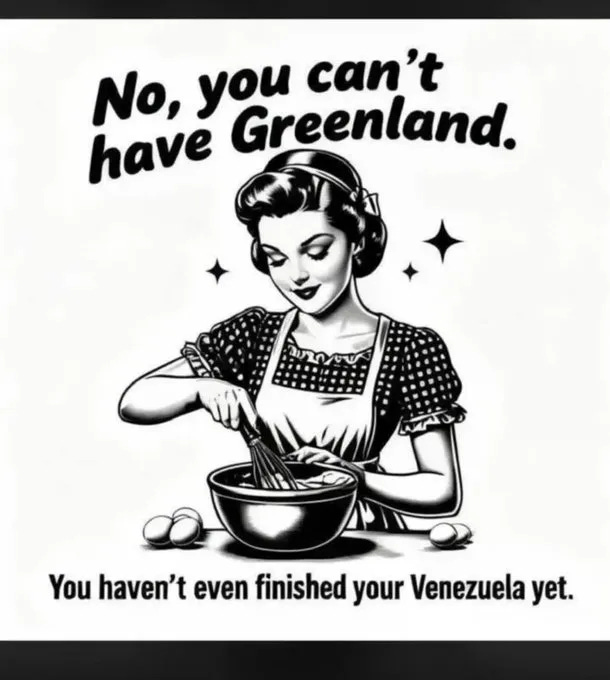
With the US, I just read a meme of a mom saying to a kid, “No you can’t have any Greenland until you finish your Venezuela.” How many fronts is the US expanding on now? [thanks again, Rat]
I’m not ruling out action. I’m actively condemning coups against foreign countries. I’m 100% for their actions to defend themselves. There’s a difference.
You say you endorse action and self-defense, but then you treat almost every concrete threat as either propaganda, power projection, or a story told by elites. At that point, nothing qualifies as a real danger — terrorism included. That’s not sovereignty, that’s paralysis.
Yes, governments lie. COVID proved that. But “they lied before” can’t mean all threats are fake or that violent regimes and terror networks are just misunderstandings framed by imperial power. Some actors really do destabilize regions, traffic violence, and ally with hostile forces — whether we like the messenger or not.
Sovereignty isn’t a magic shield that turns every action inside a country into “not our concern.” If a regime’s behavior spills outward — drugs, weapons, terror, foreign military alliances — other states will react. That’s not moral purity or imperial fantasy; that’s how the world has always worked.
Where I think you go wrong is assuming that power itself invalidates judgment. Sometimes the danger isn’t imaginary. Sometimes refusing to act isn’t ethics — it’s avoidance.
That’s my position. If you see a clear way to stop real, large-scale harm without force or pressure, I’m open to hearing it.
Alright, I’m willing to give up on coming to agreement. I’ll see if my readers can make sense of what you’re saying.
Readers, please comment below!
bonus material: is putin hitler?
That was the original title of this draft, where I’d been saving some quotes, links and memes. It’s a more feasible comparison between Ukraine and Poland in terms of military on the border and former Russians/ Germans being abused on the other side.
A nation can survive its fools and even the ambitious. But it cannot survive treason from within.
— Marcus Tullius Cicero (from the Good Citizen. Does anyone know what happened to his article comparing Russia/ Ukraine to Germany/ Poland?)
Did you know that Churchill initiated bombing of civilian cities? Or was paid huge bribes by foreigners? That he wanted to use nerve gas and even drop anthrax bombs? Or that a gambling loss on the US stock market was bailed out in exchange for war? And that FDR referred to him as a drunken bum? Ron Unz cites historians from the 1930's to the present to change your image of Churchill forever.
James Corbett and Keith Knight give 10 lessons from Churchill, Hitler & the Unnecessary War by Pat Buchanan. Ron Unz covers the same in American Pravda: Understanding WWII, and talks about prominent historians 'disappeared' from history for writing about it. The real history is shocking!
In Russell Brand's interview, Yanis states that we must always support the defenders and the sovereignty of the invaded. I question who the aggressors are and if Ukraine is a pawn. Sovereignty and the right of secession are discussed, along with whether this is Russia's war or just Putin's, as Yanis claims. I examine the role of Russian oligarch money in the demise of Greece and Cyprus, and quote Yanis from my book, How to Dismantle an Empire. I end with the hope that we're not being played by all sides, comparing them to rats at a chickenfeeder.
As the bill for the proxy war reaches $105B, Aaron Mate writes about Their Blood, Our Bullets and Glenn Greenwald shows how The Media Rewrites Ukraine's Dark History. Zelensky is presented as the second coming of Winston Churchill but don't mean his prolonging of WWII so Russia and Germany would "bleed each other dry." I quote David Zweig on the Twitter Covid dump and Jimmy Dore on right-left politics. Jeff Childers asks if there's already One World Government. And I end with Matt Ehret on China and Russia's multipolar alternative and Jessica Rose on thinking for ourselves.
The interventionists' leap of logic occurs between «situation is bad» and «action is justified». It's just a reheated version of the classic «politician's syllogism»: «something needs to be done»∪«this is something»-->«this needs to be done»:
In practice, it's perfectly OK to recognize that an outhouse stinks and at the same time not approve of driving a killdozer into it in an attempt to «fix» the situation.
There are lots of bad situations in the world that we don't know how to fix.
Turfseer- America and its western allies are superior and wiser therefore they get to be the gatekeepers of the world. And we should definitely trust mainstream media photos and history books.
Tereza- What’s good for the goose is good for the gander- If the US can seize another country (WITH HARDLY A PEEP FROM ANYWHERE) then why can’t America or Israel or any other Western country be taken over for any one of the same reasons Venezuela was? There is no legitimate reason for this take over.



The interventionists' leap of logic occurs between «situation is bad» and «action is justified». It's just a reheated version of the classic «politician's syllogism»: «something needs to be done»∪«this is something»-->«this needs to be done»:
https://en.wikipedia.org/wiki/Politician%27s_syllogism
In practice, it's perfectly OK to recognize that an outhouse stinks and at the same time not approve of driving a killdozer into it in an attempt to «fix» the situation.
There are lots of bad situations in the world that we don't know how to fix.
Can we cut to the chase?
Turfseer- America and its western allies are superior and wiser therefore they get to be the gatekeepers of the world. And we should definitely trust mainstream media photos and history books.
Tereza- What’s good for the goose is good for the gander- If the US can seize another country (WITH HARDLY A PEEP FROM ANYWHERE) then why can’t America or Israel or any other Western country be taken over for any one of the same reasons Venezuela was? There is no legitimate reason for this take over.
Did I get it right?