
Caret Convo with Tonika

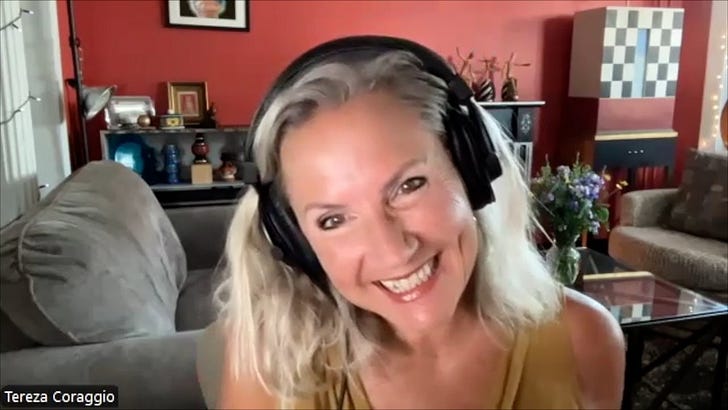
Friend and fellow Apocaloptimist Tonika of Visceral Adventures joined me to explore the monetary system in my book, How to Dismantle an Empire. We talked about credentialed clowning, the mind as the last frontier, and Goddess jiu jitsu. Tereza explained her proposal to take monetary power away from bankers by having communities create their own credit systems backed by local housing, with carets that can be used for specific categories like food, wellcare, education, home improvement and community projects. Tonika shared her background as a Bulgarian immigrant, mother, theater director, and owner of Visceral Adventure Lounge in Chicago, discussing how her experiences with free-range parenting and community building informed her perspective. They explored practical challenges including how to handle intellectual property, manage relationships between different hamlets, and transition from the current imperial currency system. The conversation also touched on the unintended consequence of the CovidCon in creating honest online relationships and a hunger for real-world hugs and smiles.
I like that the Zoom AI summary describes our strategy for global de-domination as a business meeting, complete with follow-through items and to-do lists. And that its neutrality of content treats parenting as equal in importance to cold-calling. Zoom did not produce a transcript, so I will amend their summaries and encourage you to listen. There’s a human element that’s lost in transcription anyway. At the end, I will expand on some points I wanted to make more clearly. Enjoy this warm and lively exchange!
Dismantling Economic Power Structures
Tereza and Tonika discussed Tereza’s book “How to Dismantle an Empire,” which proposes system changes to address economic issues, particularly the power of bankers over money creation. Tonika shared her background as a mother and artist, highlighting her experience managing family dynamics and running a self-sustaining community theater tour, which she sees as relevant to understanding community systems. Tereza explained how centralization of control, whether through communism or democracy, ultimately serves the interests of those who control the money supply, and they began exploring alternative approaches to create more equitable systems.
Alternative Economic Systems Discussion
Tereza and Tonika discussed alternative economic systems and governance approaches, with Tereza explaining her work on hierarchy in her book-in-progress OMGdess. Tonika shared her perspective as a “collaborative anarchist” and outlined her approach as a mother to encouraging her sons to find what gives them joy, what they’re good at, what provides something meaningful, and what will enable them to support a family. Tereza found that credentialing requirements and systemic barriers intentionally make it difficult for the younger generation to pursue work that combines their passion with a sustainable income. In both her family system and economic model, she separates the ordinary work you do that earns a living from giving the best of yourself away.
Challenges in Pursuing Creative Passions
Tereza and Tonika discussed the challenges of pursuing creative passions like theater, particularly around compensation and recognition. They explored how high salaries for famous actors and artists can crowd out community-based arts, with Tereza suggesting that lowering the bar for making a living in the arts could allow more people to pursue their passions. The conversation also touched on cultural differences in how celebrities are treated, with Tonika sharing her experience from Bulgaria where famous actors maintained more normal interactions with the public. Tereza concluded by explaining her economic system’s approach to addressing wealth inequality, particularly in housing markets, by giving residents twice the purchasing power in local currency compared to imperial currency.
Community-Based Resource Management System
Tereza and Tonika discussed the challenges of implementing a community-based caret system across different hamlets and commonwealths, particularly with wide income discrepancies with neighboring areas like Silicon Valley. Tereza explained that each hamlet would control its own property, resources and infrastructure, setting rules for external purchases and rentals to protect local interests without directly controlling other areas. They explored the potential for friction between hamlets due to interconnected resources and discussed global supply chain issues, including the reliance on materials from countries like China and Africa for high-tech goods. Tereza noted the current economic pressures and uncertainties, suggesting that future changes in global supply chains could create opportunities for more local production and community resilience.
Cultural Trends and Social Connections
Tereza discussed her recent immersion in social dancing, taking 12 classes and attending five social dances weekly across various styles. The conversation then shifted to broader cultural trends, with both participants agreeing that there’s a resurgence in live events and face-to-face interactions following the CovidCon, with Tonika delving into theater and independent filmmaking. They discussed concerns about AI’s impact on content creation and the challenge of maintaining authentic human connections in online spaces. Both felt that online communities were beacons of sanity during the gaslighting of Covid, allowing more honesty and authenticity than in real life. Now it seems like those connections are being intentionally corrupted and impeded, but also that there’s an organic turning towards nature and human interactions—touching ground and touching people. When the two converge—like Tonika and Margaret’s first hug—the result is magical.
Apocaloptimist Club
Tereza and Tonika discussed the formation and impact of Mary Poindexter McLaughlin’s “Apocaloptimist Club” for her group of women Stackers. Between Mary’s initial invite and the first zoom call in January 2024, Tonika received her cancer diagnosis, throwing them immediately into the deep end. Exactly two years ago, Margaret Anna Alice suddenly lost her husband Michael, as she movingly chronicled in her post this morning, Two Years Without. Several months later, Mary had to suddenly evacuate her house due to a hurricane, not knowing if it would be there on her return. On the heels of losing her beloved sister, she’s skirted another crisis from which she’s recovering, a story that’s hers to tell. To emphasize, this is a group of just 5-7 women. In each case, the resolution has been so unexpected as to feel miraculous and the support of the group has been heartfelt.
Intentional Community Development Challenges
Tereza and Tonika discussed the challenges of creating intentional communities, with Tonika noting that successful communities often require shared values and a higher purpose beyond self-interest. Tereza countered that people having control over their own labor with an equal distribution of resources means that they don’t need shared values. The only exception to each person having an equal share is children, whose share is held by the mother. This is a step towards matrilineal kinship groups. They explored different approaches to compensation for unique, non-replicable activities like theater versus infinitely replicable content, with Tereza giving an example of a gratitude currency for ideas that trade between communities. This is explained further in her article Five Feminine Economies.
Intellectual Property and Community Equality
Tonika and Tereza discussed the challenges of intellectual property. Tereza highlighted the need for communities to decide whether to respect patents and copyrights, noting the potential consequences and advantages of not doing so, while Tonika expressed agreement that human innovation should belong to humanity as a whole. They explored how to motivate innovation without relying solely on patents and discussed the balance between rewarding innovation and ensuring access to essential knowledge and resources.
Community-Based Alternative Currency System
Tereza presented her idea for a community-based alternative currency system where local communities could trade goods and services using “carets” while maintaining connections through a global “matrix” network. She explained how the system would work within designated “hamlets” where everyone is automatically a commoner, with exchange rates between local currencies and imperial money determined by each community. Tonika expressed interest in understanding how the system could function outside of universal participation and questioned the potential impact on confidence in the caret. Tereza responded that, if the caret is backed by local housing which can only be bought with carets, there will always be a need for it. Removing banks’ ability to create money out of thin air is the only way it can happen, not piece by piece. The conversation concluded with Tonika inviting Tereza to participate in her upcoming theatrical show at the Visceral Adventure Lounge, where they could discuss the alternative monetary system with an audience.
Additional Content
I’m so grateful to Tonika for staying with the difficulty of understanding economics, and then thinking about how we could reinvent it. This doesn’t come naturally to those of us who are artists. And it’s been intentionally obfuscated to make us think that none of us can comprehend it, much less change it.
One of Tonika’s questions that I didn’t answer was what to do about people who couldn’t make the same contribution, like people in wheelchairs for instance. This made me realize there was a core concept I wasn’t explaining clearly. So here goes:
The caret is a supplemental currency to foster reciprocal exchanges of goods and services within a community.
It doesn’t take anything away that exists now, like welfare systems or benefits.
All that it takes away from anyone is the ability of bankers to create money with a keystroke, something they were never given in the first place.
The only rules between communities are ones that keep things fair. The only rules within a community are the ones that protect their assets and keep the caret true to its purpose of reciprocity and fostering exchange.
The system doesn’t restrict what people can choose to pay others. It restricts how much they can earn or exchange 1:1 for tax-free carets. This keeps the bidding war for housing at a lower level so it doesn’t inflate, as it does now.
Subsidies must be distributed equally, but can’t be used for housing without first being traded for goods or services. To subsidize housing directly would be prioritizing some over others.
To go back to our family analogy, let’s say you subsidize housing for artists while others have to provide something that their neighbors buy before using the carets for housing. It would be like saying ‘Your brother’s an artist! He can’t be bothered with washing dishes. You’re a drudge! You should wash the dishes for him.’ Not fair! as any kid would retort.
Within the categories of food, wellcare, education, home improvement and community projects, there’s something any differently-abled person can do. People are generous and want to encourage others. We know this. I think our communities, like our families, wouldn’t leave anyone out who wanted to participate.
For Mother's Day, here are my hopes and dreams for five feminine economies. I develop a subsistence economy with neighborhoods involved with farming and animal husbandry. A reciprocal economy for local goods and services, as explained in my book, How to Dismantle an Empire. An edu-travel economy for a lifetime of learning around the world. A hosting economy with travel vouchers and sibling cities. And a gift economy for all things infinitely replicable like ideas, writing, music and open source software.
The Caret System, from my book How to Dismantle an Empire, is the most perfect anarchist economic system there is. I challenge anyone to improve on it. Please. Here are the principles, goals, rules and tools for Restoring Local Sovereignty, a playlist linked at the end.
In my interview of Gabriel of Libre Solutions Network, we talk about solutions and the messiness of real life interactions. We discuss my caret system and how it could be turned into a simulation. Gabe expresses that the bar for making a difference is much lower than people think.
VN Alexander interviews me on my book, How to Dismantle an Empire. From her background as an author and philosopher of creativity, we find much common ground on which to build an economic system that strengthens the self-reliance of families and communities. Sadly, Victoria's face disappears 10 min in, but her voice continues the vibrant conversation.
Nick reviews my book, How to Dismantle an Empire. We talk about the importance of defining terms and the courage of proposing a solution. He quotes the thesis of my book and I outline the progression by which I get there. We talk about the capitocracy and illusion of democracy. It's a lively and hopeful exchange on a new economic model and how much fun that could be.
I haven’t stopped thinking about the conversation because I wholeheartedly believe our current monetary system sucks and is in desperate need of an overhaul. I wish I knew more on the subject of economics. I appreciate you giving me a chance to share my pedestrian perspective on it. Ultimately, I still find our challenge to lie within human behavior and the leviathan that is the pre existing empirical structure. But we can start with making sure the bankers don’t make money up out of thin air. That is a solid start.
I will share your post on my stack in the upcoming days too. Many thanks again.
Very glad to see more of this series and you both! Before this came out I was recently thinking that my go-to response to people saying "X political fight is the point of no return" is telling them they need to read How to Dismantle an Empire. That's where you saying "you stop the bankers from making money at our expense all at once or not at all" gets to the meat of it.
I've also been somewhat more disengaged from online commentary and ingesting information, but a lot of that has to do with me trying to get outside and enjoy the summer. In a time were you can generate anything that can look "good enough" I am often asking myself what actually needs to be said. It's been wonderful to see the VAL blossom and I know you'll greatly enjoy meeting! I really loved what you said Tereza about online connections often being a lot deeper and meaningful than connections via mere geography. I can personally say that's something I find myself missing a lot as my life has shifted around.
Speaking as someone a generation later, I would definitely say younger people are desperate to actually participate in the work of society, there just seem to be all these inane barriers like the ones your son-in-law encounters. I remember a conversation we had years ago Tereza, where you told me the collapse was inevitable, and I'll admit I didn't quite understand at the time. I think I'm beginning to actually see it. I jokingly told someone recently "we've run out of corners to cut and all we see are circles".
Great conversation, and I'm definitely looking forward to future installments!