
Death & the Goddess
and lessons 31-40 in a course in goddess

This episode is dedicated to Jane, the sister of Mary Poindexter McLaughlin, whose passing Mary has honored with her very tender essay on her Substack, The Art of Freedom. Jane was a woman of great intuition and wisdom, two qualities that Mary has in abundance. Here, I’ll be summarizing from The Living Goddesses by archeologist Marija Gimbutas, to look at the stories and rituals surrounding death in the Neolithic Goddess societies, and how they reflect a different understanding of the beside-life, rather than the afterlife.
In the book I’m writing, OMGdess, I start with a chapter called Time Out of Mind. It distinguishes between Reality and perception. The stories we tell can’t change Reality but they certainly alter our perception of it. A Course in Miracles says its teachings can be summarized in three statements: ‘Nothing real can be threatened. Nothing unreal exists. Therein lies the peace of God[dess].’
This also means that nothing real can ever be lost. However, abstractions are all well and good but not very comforting when you’re missing a particular form, a voice, the person who would get that joke like no one else, the one who could help sort out your feelings. Those are the particulars of a unique individual that no one else can fill. And that grief, for which I have no wisdom to offer, breaks our hearts.
to excarnate, to incarnate
In Marija Gimbutas’ The Living Goddesses, she delves into the symbology of burial rituals as uncovered by archeology. What struck me were the similarities from Old Europe to Egypt, from Sumer to Anatolia, from the Mediterranean to the Celtic islands. They had similar manifestations of Goddess: The horns that Marija describes as a bull’s, topped the corners of temples in both Sumer and Crete. She writes:
The spectacular temple complexes, with hundreds of ‘horns of consecration’ (models of bull’s horns) lining their roofs and terraces, unequivocally attest to the active ritual life of the larger Cretan towns. However, archaeological evidence also reveals that shrines and temples distinguished smaller Cretan towns and even the countryside. The Minoans venerated the same deities everywhere and performed related rituals. Further, the spiritual and secular ways of life were closely intertwined. [134]
However, the female auroch, the wild predecessor of domesticated cattle, had horns too, so these may be the cow Goddess Baat. Burial rituals also showed similarity as a two-step process. In the first, the body of the beloved would be allowed to excarnate—to lose the flesh from the bones. In Egypt, the body was laid on elevated platforms where Nekbeht, the Goddess as griffon vulture, could take the flesh into the heavens. She represented purity, eternity and the fierce nurturing protection of the mother.
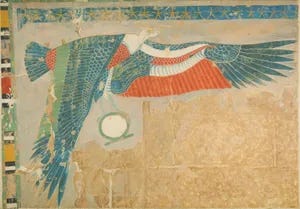
The Greek Athena traces back to the Old European vulture Goddess, and according to Homer, could change into one. But Homer adds the Aryan trappings of war garb, turning her into a destroyer rather than an escort of the already dead into the next life. [158] The Sirens and Harpies have a woman’s head with the body and feet of a vulture, the better to lure and snatch a man to his death.
In prehistoric Europe, the vulture had breasts, combining regeneration as immediately following death. In these cultures, time moved in cycles or spirals, not in a straight line. The Goddess ‘brought death yet ruled life and assured birth.’ [Gimbutas, 21]
from tomb to womb
In Old Europe, the body was first placed in caves of the priestess. Gimbutas writes:
Caves, with their hidden, cool atmosphere, stalagmites, stalactites, and underground streams, exude a mysterious quality perhaps equated to the regeneration of life itself: the enclosed spaces of caves symbolize the birth canal and womb of the goddess. [60]
In underground tombs of Malta, Italy, Sardinia and France, egg-shaped chambers were cut into rock with the skeletons found in a fetal position. Red-ocher, the color of life, was painted on many chamber walls with pomegranates depicted.
The Atlantic islands of Ireland, Scotland and England performed the first burial of the body in coastal caves with rituals of remembrance at 5 days, 60 days, and six moons. But the most important was at five years, when the bones were retrieved by the priestess, bundled in cloth, and ceremoniously paraded to an ossuary. These were megalithic mounds of stone, dazzled with quartz carried up the hill by loved ones.
In Odysseus and the Sea People, Edo Nyland deciphers words from the Neolithic Basque origins. Krystallos means ‘A fragment of nature’s flawless rock fills with joy and induces healing.’ Quartz from volcanic granite is ‘a small rock which gives welcome peace of mind.’ After five years of rest within the Goddess, the spirit is ready to reincarnate and is placed in the stone womb sparkling with light. The timing of this cycle seems peaceful, with five years of respite and regeneration.
temple of the mother
Other cultures buried the bones beneath the bed, keeping the spirit close. This was particularly true for children, who were buried under the same bed as the mother, but whose bones were never found with an adult male. Burials under a central house was almost always an older woman, surrounded by smaller structures. This formed a nucleus with a guardian spirit, a multifunctional temple with an oven for bread and communal meals.
In the cemeteries of family groupings, the females and children are related by blood but not the adult men. This reinforces that communities were matrilocal and men were more nomadic and came to the woman’s kinship group. These weren’t rules but merely default custom, so that every child would have a place to belong, and share in her or his family land. Brothers were expected to take responsibility for helping to raise their sister’s children.
Women were considered parthenogenetic, creating life out of itself—which is true except for a single sperm cell. Gimbutas clarifies:
… in many societies females did not mate for life with their male sexual partners. This would lead to an inability to establish paternity, the identity of the exact biological father of a woman’s child. Establishing paternity is one of the cornerstones of later patriarchal cultures, which insisted on controlling women’s reproductive behavior. This inability to establish paternity has an effect on social structure because, when the biological father cannot be determined, the mother and her kin automatically are the focus of the family, and the family structure is matrilineal. … Just as the female body was regarded as the goddess creatress, so too the world was regarded as the body of the goddess, constantly creating new life from itself. [112]
The concept of paternity—the child being a man’s own[ed]—destroyed the social structure that prioritized the wellbeing of a child as the community’s responsibility. It introduced an ego-based relationship of the child as continuing a lineage, rather than a belonging, as every child belonged to her or his mother without needing to be claimed as worthy or legitimate.
At Çatalhöyük in modern day Türkiye, the skeleton of an older woman was buried under the floor of a shrine room with an 18 meter painting of the city itself from 9000 years ago. She was found covered in jewelry, as a revered ancestor. However, the word ancestor comes from the prime-father god An, so the word negates the concept.
henging all bets
The Atlantic isles of Ireland, Scotland, Wales and England are famous for their henges, also called roundels. These are laid out in concentric circles that enclose a sacred ceremonial space. The outer perimeter was a ditch with an exact radius to the center, followed by a bank and a palisade or fence. In Denmark, the ditch digging alone for one enclosure has been calculated at 985 days with the whole project taking 4000. But a community could have completed it in three months. Thousands of oak trees were felled for the palisades. Stonehenge is the most famous but there are a hundred in Britain’s countryside alone, with monumental upright rocks weighing several tons.
They first emerged in central Europe around 5000 BCE. The fences always had gated openings on the East and West, aligned with the azimuth of the solar equinox, and often also to the North and South. Some sacred spaces are 10-20 meters across while others extend over 300 meters in diameter. Enclosures have been found but they never obstructed the cardinal axes. The ones in the Western corners were underground spaces that symbolized winter and retreat. Those on the Eastern side were above ground and joyous, with colorful murals symbolizing spring and birth.
Ritual artifacts and votive vessels confirm religious use and celebrations. There were sometimes processional avenues laid out to other sites. The 28 acre Avebury roundel has 98 upright stones and two serpentine stone avenues 2.4 kilometers long and 19 meters wide. One with two hundred standing stones leads to the Sanctuary with the ritual burial of a female fifteen years old. She is in an upright fetal position.
Although no cemeteries have been found, there are individual burials in tight fetal positions. Women over sixty years old are most common, and one man over sixty. Some are very young children from newborn to seven, generally laid on their stomachs. At the very center of one roundel was a Goddess figurine and a human skull. These seem to be burials of honor and not sacrifices—no marks of traumatic injury have been found.
Stonehenge went through three phases. In the first, 56 cremation pits ran just inside the outer bank. Stonehenge II had an incomplete circle of 82 beautiful blue stones on an avenue leading to the river Avon. The final iteration, which we see today, demolished the blue stone circle and erected the U-shaped monument of five upright pairs joined by a lintel. Around this are eight sarsens or sandstone boulders in a 30 meter circle joined by a lintel stone ring. Gimbutas writes:
It is very possible that roundels were sacred places, dedicated to the goddess. Aligned with the cosmos, the territory of the roundel may have replicated a symbolic universe. Thus, a cosmic ideology may have motivated these Old European cultures to build such large-scale monuments. Through ritual in these monuments, they would have honored the Old European goddess of death and regeneration.
a course in goddess, lessons 31-40
I am not the victim of the world I see.
I have invented the world I see.
There is a different way of seeing the world.
I could see peace instead of this.
My mind is part of Goddess, I am very holy.
My wholeness envelops everything I see.
My wholeness blesses the world.
There is nothing my wholeness cannot accomplish.
My wholeness is my salvation.
I am blessed as the One of Goddess.
These lessons follow on from the first 30 in A Course in Miracles, which I’ve translated into Goddess. This decade of meditations is the turning point from undoing the world’s way of thinking/ perceiving to retraining the mind to see differently. In 31, it undoes the belief that the world creates reality and you then react or adapt.
Instead, you are the one inventing the world you see. You can change what you see, your perception of reality. You can never change Reality because, by definition, Reality is what exists regardless of your perception. If what you see doesn’t evoke peace in you, however, you’re not seeing Reality. What you’re seeing is a meaningless world.
In my practice, I’ve changed 34 to ‘I do see peace in all of this.’ It’s not a potentiality for me, nor does it need to be for you. Whatever happens in the world or your ‘life’, take the future worry out of it and the past regret. Say to yourSelf, ‘Goddess got you,’ and see what happens.
The only way to see Reality as it is, is to see with the Mind that’s part of Goddess. Retraining your mind to be Mind requires discipline, reforming all habits of mind. It doesn’t happen without work. Your Mind is holy because it’s whole with Goddess. I’ve changed holiness to wholeness because they’re the same. Thinking with your Whole Mind is tapping into Goddess Mind, the part that doesn’t need to know the meaning to know that meaning is there.
Lesson 38 is one to truly internalize: There is nothing my wholeness cannot accomplish. Nothing. Let me say again, nothing. Any limitation you’re placing is your own self-sabotage. The whole ‘prosperity consciousness’ is silly. You don’t need prosperity to prosper: that’s the Whole point. When Marianne Williamson says that we need to change things NOW, she’s not understanding the Course she teaches. You don’t need to change anything but your mind, but don’t underestimate that endeavor.
Salvation requires some interpretation because it’s been usurped and twisted. You don’t need saving. You’re better than perfect because perfect would imply a pre-existing mold you fit into. You’re beyond all molds because you’re breaking out of them as soon as they form around you. As soon as you imagine the world, it becomes a stepping stone to what you haven’t yet conjured into being. Maybe salvation is a salve to lubricate the synapse between your mind and Goddess Mind.
Lesson 40 has been changed from ‘I am blessed as the Son of God’ to ‘I am blessed as the One of Goddess.’ After 5000 years of the ‘triple masculinity of divinity,’ we’d be justified in saying Daughter of Goddess and letting men try that on; see how it feels to deny your gender as a spiritual being. However, it doesn’t fit the cadence. Daughter is a clunky word that’s been thrust on us. Goddess is One and we are One with Goddess.
There is no male and female. There is no you and me. There is no Goddess and us. There is only One Mind. We’re not a part of it, we’re All of It. That Mind is parthenogenetic—creating life out of itself. We are all female in Our Mind because we are creating life. Within this dream of life, mothers are the closest reflection of Goddess Mind. Men need to learn from their intuition and nature, not compete with it. Once you identify with your role in the dream, you’ve missed the point.
Peace is the point. What is Real can never be lost or threatened. Nothing unreal exists. Therein lies the peace of Goddess.
back to the point
What I would usually say to someone in Mary’s position is ‘I’m wishing you a peaceful heart.’ But she already has that. What I would say to Jane is ‘Go with Goddess.’ But she already has.

In this episode, I read my poem called Becoming Yeast and talk about prayer and forgiveness. I ask whether two people asking the same question, with more concern for getting the right answer than being right, is a special form of prayer.
Tonika of Visceral Adventures has animated my poem, Drops of God. Set against cascading, surreal artwork, this mystical poem speaks of Oneness and uniqueness, eternity and immortality in the I of the beholder. The music is Dreaming Of You by Natalia Kolesnikova, who graciously allows her music to be used.
Beautiful, Tereza.
Funny about Maryanne Williamson- I saw a video of hers that was super cringe. I haven’t been able to look at her the same since. She strikes me as someone who maybe read the books we read but attempts to use them as manipulative weapons. I could be wrong. But just getting that vibe.
Thanks for the herstory lesson.