Isaac Middle of Down the Wombat Hole invited me to riff on two of the fixed luminaries in my star chart. I apply my research for OMGdess to give a prehistoric perspective on the constellations before patriarchy. I also add personal details from my own life and psychology, finding the lesser-known signs to be nuanced and insightful.
poetry in emotion
Isaac introduced me to the fixed stars through a collection of essays by Chloe Margherita. I replied to him, “What a gorgeous writer Chloe Margherita is! I had to look up psychopomp and now it’s my favorite word. Although 'leaning into my intractability' certainly stuck a chord.” I recommend reading her for yourself. To instigate that end, here are some breathtaking quotes:
Fixed stars are useful in the way that poetry or myth or art is useful: they are all psychopomps, getting us past the thinking mind to the wisdom of the heart and soul. Though it may not always seem practical, knowing the soulful source of your life, is enough to change everything. Not only are we connected with the stars, but we can call on them to shift our earthly lives in alignment with our desires and spiritual paths.
Fixed stars are an excuse to lean into your weirdness, your intractability, all the parts of you that “don’t fit” into mundane, earthly society. Rather than being concerned with mere material gain, the stars wish to sow the will of the heavens into your life, even if that strays your life’s unfolding from your plans.
There are stars of passion, of softness, of sacrifice, of wild creativity, blinding light, constant transformation, of witnessing the dead. There are whole cities within each star, teeming with life and complexity, interwoven meaning.
The fixed stars cannot fit solely into earth time. Neither can you.
Especially for my fellow poetry lovers, Chloe then quotes some of her favorite poets who mention the fixed stars:
“Half Light” by Frank Bidart:
The crazy drunken night Imaneuvered you out into a field outside of
Coachella— I’d never seen a skyso full of stars, as if the dirt of our lives
still were sprinkled with glisteningwhite shells from the ancient seabed
beneath us that receded long ago.
"Legend" by Louise Glück:

Through the great soul is said to be
a star, a beacon,
what it resembles better is a diamond:
in the whole world there is nothing
hard enough to change it.
The planets are the wandering stars because they orbit the same sun we do; we are on the same journey taking different paths. They’re our intimate stars. The fixed stars are immutable to us. They are the foreign suns of another sky, around which another solar system rotates. They are a universe unto themselves in the multiverse of infinity. When we draw closer to them in our minds, we’re responding to the warmth of other suns. In the book of that name by Isabel Wilkerson, she starts with the poem by Richard Wright from which she culled the phrase:
I was leaving the South
To fling myself into the unknown ...
I was taking a part of the South
To transplant in alien soil,
To see if it could grow differently,
If it could drink of new and cool rains,
Bend in strange winds,
Respond to the warmth of other suns
And, perhaps, to bloom.
Chloe brings this back to the complementary meanings between our domestic planets and those farflung suns:
Even the most mundane, earthly, “base” parts of our lives— our toils and worries and obligations and pains— are influenced and intermixed with something ancient and pure. I often tell my clients that while the planets, or wandering stars, tell us about our family, our body, all that we must do to survive on this planet, the stars are concerned with something less immediate and practical: our purpose. Understanding all the stars in your chart connects you to this ancient blueprint.
What I love about the fixed stars is how immediately poignant and deep they are to anyone who encounters their shine, whether that be reading about them or gazing upon them in the sky. I spend so much of my time exploring and studying them because they somehow connect me more deeply to both my place on earth and my place among the stars.
Writing like this brings tears to my eyes. What a sap! I can’t help it. The words resonate like the thrum of a sympathetic piano wire inside me. It will not be my last encounter, I suspect, with Ms. Margherita.
geeking out
My foundational and only belief is that people are inherently good and, when they behave badly, systems and stories are to blame. What many miss when they argue against my belief is the phrase ‘when they behave badly.’ In some cases, very badly. Systems and stories of superiority enable widespread horrors through obedience to authority. Authority depends on the belief that others are better than us. We buy into that belief because it makes us better than others. That’s hierarchy, rule by divine heir.
The building block of all stories are words, each of which is a capsulized metaphor. To find out what came before his-story, what was erased and overwritten like a palimpsest, requires linguistic anthropology especially into the names. It also needs mytho-anthropology into the stories that form our paradigms, our pre-thinking, into human nature and the divine order. I do a lot of that. Here I want to do something else.
What is the building block of systems? Numbers. How we count determines the way we organize data. It seems like such a rudimentary thing. And it is! Rudimentary comes from rudiment, coined in the 1540’s as the element or first principle of science or art. It’s from Latin rudimentus for ‘first experience, early training, beginning,’ which comes from rudis for ‘unlearned, untrained.’ So let’s get rude and question those stepping stones!
Base-10, where the second digit represents 10 units of the first digit, is divisible by 2 and 5, skipping the primary primes of 3 and 4. Its adoption—despite its inefficiency—is explained by Neanderthal men having five fingers on two hands. But we know that Stone Age women were calculating astronomy, measuring pyramids, extracting energy from stone, and determining the geographic center of the world’s largest land mass. We haven’t come as far as we think by counting on our fingers.
The advanced primes enable one to do more complex mental math with bigger numbers. Skipping 5 and adding 3 and 4 gives the next prime of 7 for the week. Going back and adding in that 5 gives the prime of 13 for the months, each with 28 days. But it leaves one day out, coming to 364 days. A five-day week divides 365 evenly into 73, which is the 21st prime, twinned with 71, which is the 20th.
73 is called a Sheldon’s prime because of its symmetry: its reverse, 37, is the 12th prime and its digits multiplied together 7*3 = 21, its placement as a prime. In binary, it’s a palindrome reading the same forwards and backwards as 1001001. It’s also a palindrome in Base 8, Octal, at 111.
Base 10 forces us to think crudely and rudely, dividing only by 5’s. It’s my contention that we’re in numeric kindergarten, still counting on our fingers. The zodiac should be 13 months at least, overlaid with divisions into 73 for the advanced class. Or maybe instead of 4 years of 365 days + 1 for leap year, equalling 1461 days, we should have 3 years of 487 days. That would be calculating at a fine nuance.
zosma ascendant
Zosma is the tailbone of the constellation we call Leo. The heart of the lion is Regulus, one of the brightest stars. This is a royal star and seen as stalwart, brave, victorious in conflict and war. Zosma is the forgotten, the abused, the ones most left behind. It’s the oracle of the victim, the one who speaks for the silenced.
How did the constellation become a lion? The story is that Heracles, in order to become a heiro, had to accomplish 12 tasks. The first was to kill the Nemean lion who was terrorizing the population. Its fur was so thick it was like armor and couldn’t be pierced with an arrow/ hiero.
Heracles engaged in hand to paw combat with the lion! He broke its back, right at the point of Zosma, killing it. Then he wanted to skin it but couldn’t figure out how to cut through the fur. One of the gods whispered into his ear, “Use the claw!” Heracles did and made himself a cloak of the impenetrable pelt with the head as a helmet. He became the Nemean lion.
Because the lion had died nobly, Zeus threw its (skinned?) body up into the heavens, making it the constellation Leo. The Nemean lion is said to be brother to the Sphinx and to the serpent Ladon. So let’s examine this.
The great stone monument later called the Sphinx was originally the lioness Mehit, Goddess and guardian of the Nile. The Nile itself may have been the great serpent Ua Zet that later became the Goddess Au Set. Lotan, Leviathan or Ladon were all different names for the serpent/ river aspect of the Goddess.
The Aryan Patr-archons couldn’t penetrate the Goddess culture because the protective fur of the community was too thick, like armor. Instead they infiltrated, coming close. The name Heracles, later changed to Hercules, contains Hera, wife of Zeus, with the ending of cule, meaning for fame, to hear about. The Aryans came in close, with stealth, like a trusted partner. Then they turned and used the weight of Mehit against her, breaking her back.
The false goddess whispering in Heracles’ ear is a masculine projection, saying to turn the weapon of Goddess against her. This may have been her own military or personal guard, or even the son/ consort. It was certainly the men sowing discontent within a society in which women controlled their own bodies.
After taking away the protective garment from the lioness, the Heiro wears it as a costume. He disguises himself as a god in the trappings of the Goddess. The transition is complete.
the voice of zosma
I relate hard to Zosma. Some say that, rather than being conflict-adverse, I am conflict-attractive, and it can seem that way on some days. But actually I am conflict-tolerant because I don’t think you can cause conflict, only bring it to the surface. The only thing I ever argue against is whether we are superior to others. And that keeps me in conflict most of the time.
Most people don’t argue that they’re superior to you. When they do, that’s a fun conflict because it’s no-holds barred. The difficult conflicts are on the same side. The seduction of superiority is what creates a group identity as different than the rest. Those you’re superior to aren’t present, because they’re not part of the group.
So when I argue, I’m defending the invisible victim who’s not there to speak for themselves. I’m disrupting a false peace, a Pax Romana/ Brittanica/ Americana, the ‘peace of god’ in which supremacy is taken for granted by everyone in the room. Making that assumption visible leaves me open to attack because people think I’m claiming my own moral superiority. But that’s okay. I’m Zosma.
Zosma is also the oracle and that’s an important difference from god worship/ war ship. Gods require sacrifice and supplication, to boss them around and get them to do what you want. With Goddess, she already wants what’s best for you and everyone else. You are there to listen.
Isaac summarizes Zosma:
Constellation: Leo the Lion
Planetary Nature: Saturn and Venus
Zodiacal Degree: 11º40’ Virgo
Greek Myth: Hercules and the Nemean Lion
Prophetic Ability
Artistic Ability
Sacrifice
With its proximity to Regulus, Zosma cannot be fully removed from the influence of the star most linked to earthly power and rulership through conflict. Zosma seems most related to those who are victimised or marginalised by this approach to Power: and with Regulus representative of a highly masculine approach to power, Zosma thus represents the “victimised” feminine. More than that, and when understood in its own context, this feminine energy presents in a highly “Venusian” manner: through Goddess worship, creative artistry, and oracular powers.
the nebulous denebola
And here is Isaac on Denebola:
Constellation: Leo the Lion
Planetary Nature: Saturn and Venus
Zodiacal Degree: 21º57’ Virgo
Greek Myth: Hercules and the Nemean Lion
Rebellion
Power
Transformation
Animal Nature
The Tail of the Lion, Denebola’s associations to Leadership and Power in ancient interpretations is suggested to come at a personal cost – Margherita points to Denebola native Kurt Cobain as a prime example of the path to some kind of public infamy and disgrace – that may ultimately lead to ambivalence, rejection and/or subversion of power. Ultimately, the native finds they cannot wholly reject Power, and thus find it in marginalised and decentralised ways: bringing a disruptive but also highly transformational energy.
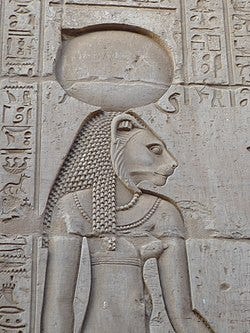
Denebola is still connected to royalty but in an agitated, swishing pattern. It can also be peaceful and healing, signaling calm and contentment. Denebola is also Sekhmet, the earliest depiction (they say) of the lion goddess because she had the head of a lioness and the body of a woman. From Wikipedia:
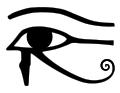
Sekhmet acted as the vengeful manifestation of Ra’s power, the Eye of Ra. Sekhmet is said to breathe fire, and the hot winds of the desert were likened to her breath. She is also believed to cause plagues (which were described as being her servants or messengers), although she is also called upon to ward off disease and heal the sick.[4]
In a myth about the end of Ra’s rule on the earth, Ra sends the goddess Hathor, in the form of Sekhmet, to destroy mortals who conspired against him. In the myth, Sekhmet’s bloodlust was not quenched at the end of battle, and this led to her going on a bloody rampage that laid Egypt to waste and almost destroyed all of humanity. To stop her, Ra and the other gods devised a plan. They poured out a lake of beer dyed with red ochre so that it resembled blood. Mistaking the beer for blood, Sekhmet drank it all and became so drunk that she gave up on the slaughter and returned peacefully to Ra.[5] The same myth was also described in the prognosis texts of the Calendar of Lucky and Unlucky Days of Papyrus Cairo 86637.
In other versions of this story, Sekhmet grew angered at the deception and left Egypt, diminishing the power of the sun. This threatened the power and security of the world; thus, she was persuaded by the god Thoth to return and restore the sun to its full glory.[7] Sekhmet’s feline attributes and her iconography sometimes make it difficult to differentiate Sekhmet from other feline goddesses – mainly Bastet.
Sekhmet was considered the wife of the god Ptah and mother of his son Nefertum. She was also said to be the mother of the lion-headed war god, Maahes. She was also considered to be the sister of the cat goddess Bastet. The lion-headed goddess Sekhmet is the most represented deity in most Egyptian collections worldwide. Many amulets depict her image, and her numerous statues abound in Egyptian art. Many of her statues can be found in museums and archaeological sites, and her presence testifies to this goddess’s historical and cultural importance.
Instead of Mehit being the lioness guardian of the Nile and the whole constellation, she’s now demoted to the tail as the wrathful vengeance of the sun god, Ra. Fire, hot winds, plagues, and a diminished sun are all blamed on her. Hathor, who replaced the Cow Goddess Baat, now becomes Sekhmet, a vicious creature drunk on bloodlust.
the charismatic heretic
Chloe Margarita calls Denebola ‘the reluctant ruler’ and ‘the charismatic heretic.’ She is involved in other people’s lives, is the cause of exciting events, and looks at power in decentralized ways. This describes what I do.
In a personal sense, the tail is a place of loneliness. It’s going to the extreme of the first cause. In The Creation of Patriarchy, Gerda Lerner says that men have written the myths. They’ve devised the stories that we use to interpret events and what they mean. To question those myths means being okay with intellectual loneliness.
The tail doesn’t have an effect. It maybe gives a warning. It connects the cause and the consequences. In this way the tail moves the body. Using the claw to tear open the heart of the lioness is using her own children against her. That’s what can lay bare a mother’s heart. Now is the time of healing and heresy—her I see.
the tale of the zodiac
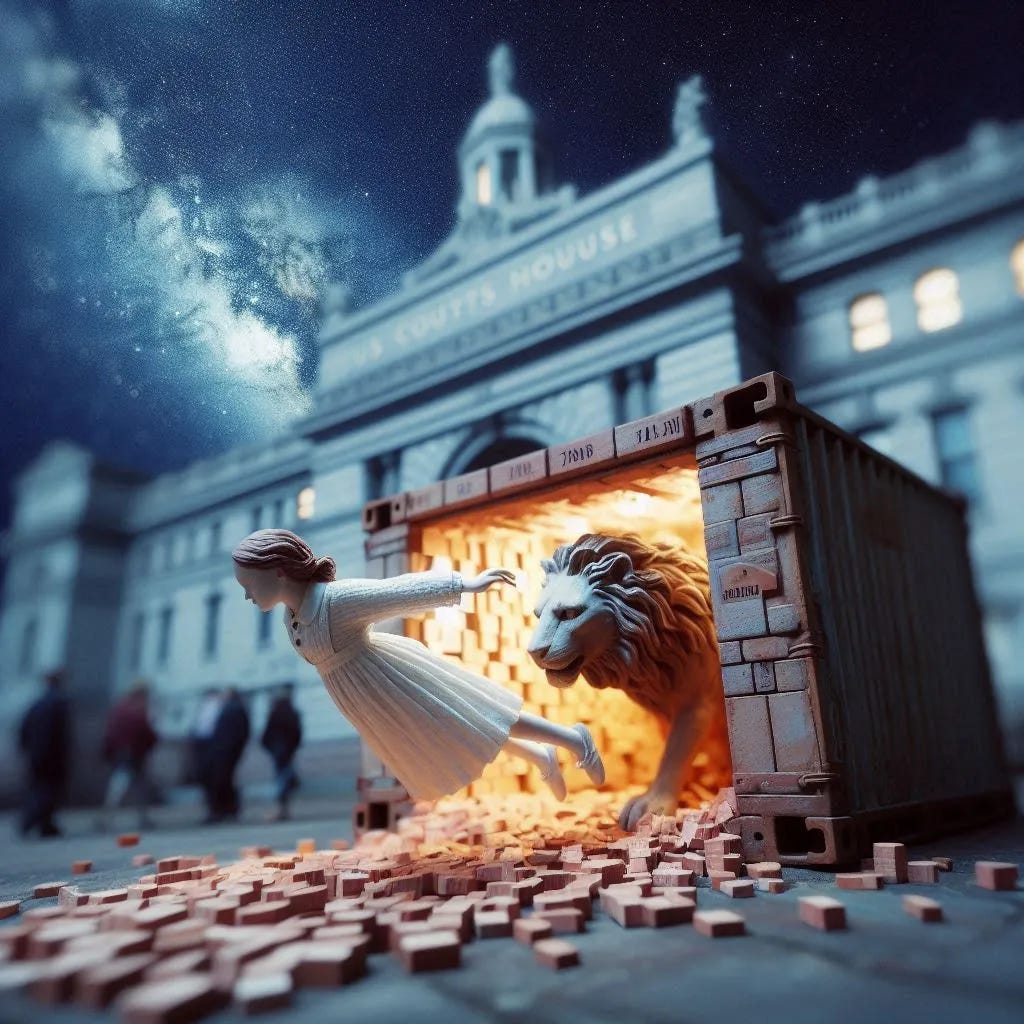
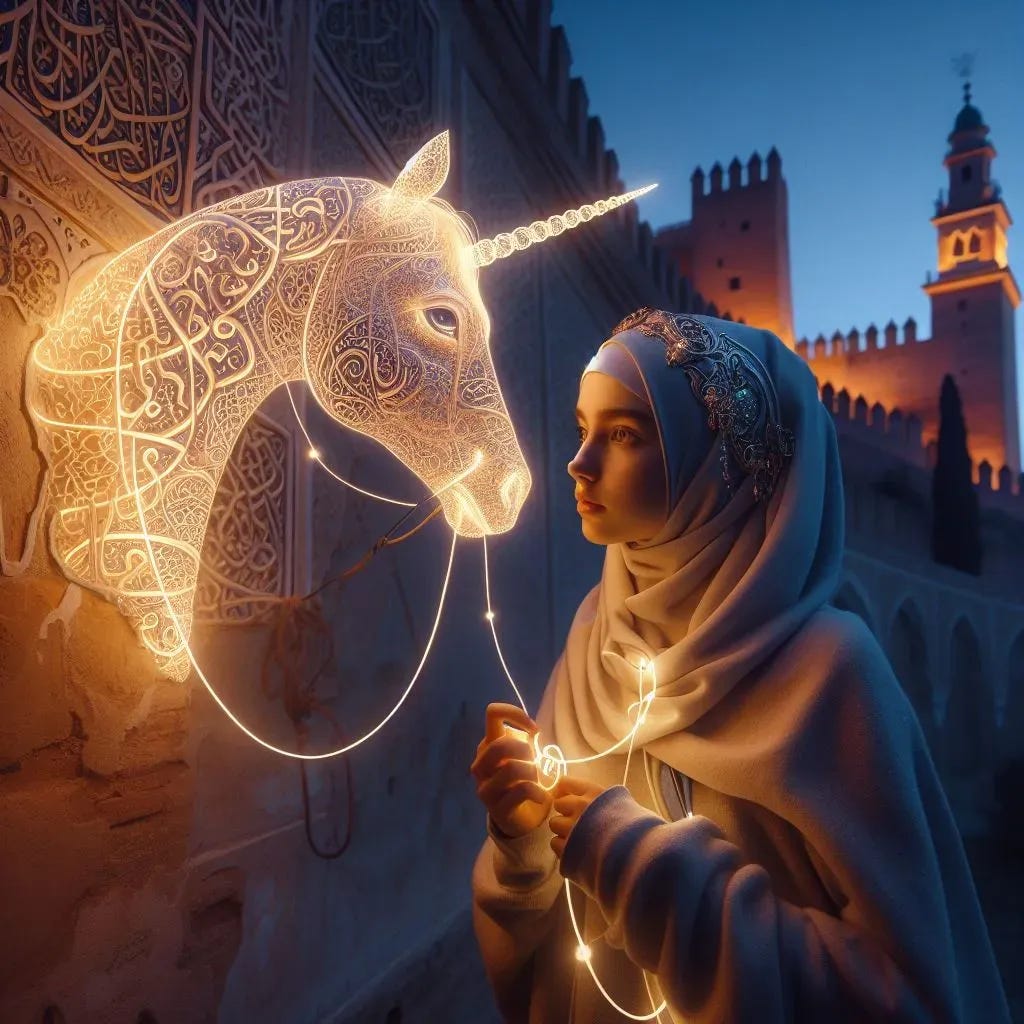
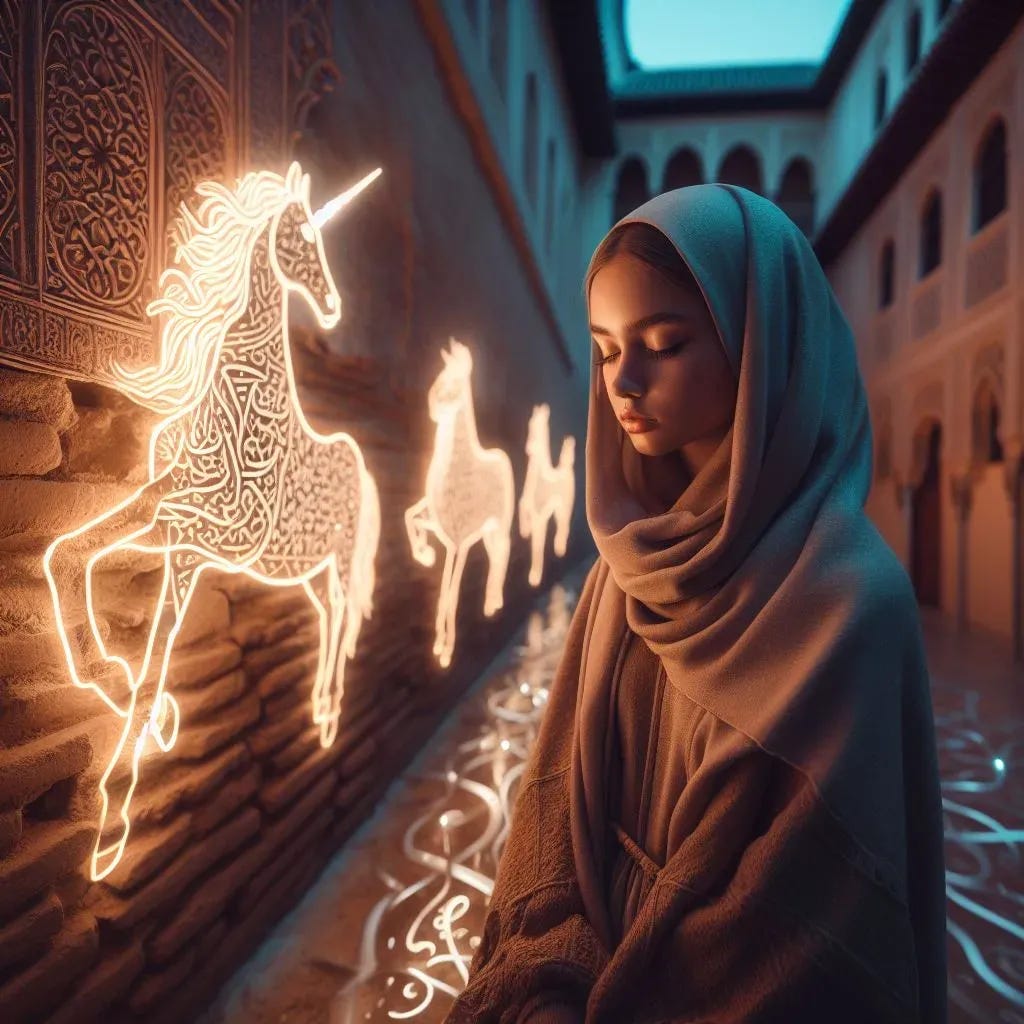
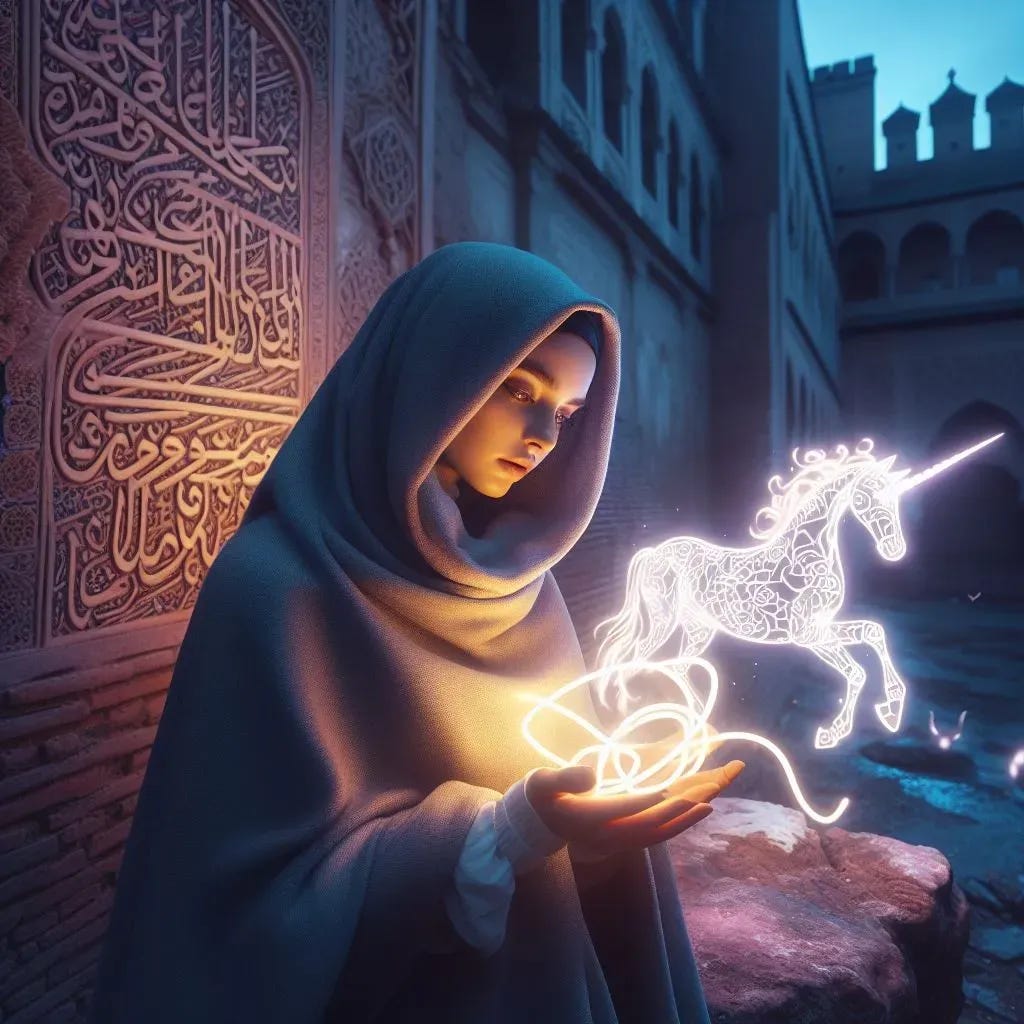
Just for fun, here is the Great Year in duodecimal (Base-12), with some new associations, followed by AI art by Amy Rosebush for the besieged maidens of the Middle East today:
Libra : 1-1300 : 15,268 to 13,108 BCE : Newborn Age
Virgo : 1-1300 : 13,108 to 10,948 BCE : Maiden Age
Leo : 1-1300 : 10,948 to 8788 BCE : Age of Mehit
Cancer : 1-1300 : 8788 to 6628 BCE : Vinca Age
Gemini : 1-1300 : 6628 to 4468 BCE : Harappan Age
Taurus : 1-1300 : 4468 to 2308 BCE : Age of Baat
Aries : 1-1300 : 2308 to 148 BCE : Aryan War Age
Pisces : 1-1300 : 148 BCE to 2012 CE : Nicene Ruler Age
Aquarius : 1-1300 : 2012 to 4172 CE : Age of Awakening
For my 67th birthday, I claim my power as a geriatric sx symbol, explain why young women particularly need hope, and tell my genius trick for putting your multiple personalities to work. I detail Isaac Middle's wholesome astrology chart, complete with Vedic nakshatras or lunar mansions. And I tell why we need the temple of Auset/ Isis to re-member the 13 pieces of Ausir/ Osiris, to heal the wounds of the last four years and the last four millennia.
Isaac Middle is the Australian author of Wholesome Conspiratorial Astrology. From his 90-pp reading of my chart, I explain the differences in Vedic, True Sidereal, Sidereal and Tropical, Raku and Ketu and the Nakshatras. Then I read Luna's view of plotting a revolution with a Plutonic Power Generator, Holy Warriors, and a Spiritual Messenger from the Past.
I use two Celtic Cross readings of two Tarot decks to tell the story of how the Goddess societies were destroyed 5000 yrs ago and how the Goddess is returning now. The masculine reading, done by Isaac Middle, is from the traditional Rider–Waite deck. The feminine reading is from Universal Folk Tarot by Anita Inverarity. They tell a tale of hope and uncanny synchronicity.
I'm glad you have resonated with Chloe's beautiful writings, and also glad that my distracted tardiness has not stopped you from getting this up! The spirit of both Zosma and Denebola absolutely shine through in you (and it feels like there is a lot more that needs to be unpacked in that Heracles myth and how it is still playing out)
I love your posts, though not in alignment with a few things....since you are exploring fixed stars, you may enjoy this article as a sample of what my school is up to:https://turningoftheages.com/what-does-in-virgo-mean/


I'm glad you have resonated with Chloe's beautiful writings, and also glad that my distracted tardiness has not stopped you from getting this up! The spirit of both Zosma and Denebola absolutely shine through in you (and it feels like there is a lot more that needs to be unpacked in that Heracles myth and how it is still playing out)
I love your posts, though not in alignment with a few things....since you are exploring fixed stars, you may enjoy this article as a sample of what my school is up to:https://turningoftheages.com/what-does-in-virgo-mean/